


Why Did Bitcoin Go Up When Interest Rates Went Up?
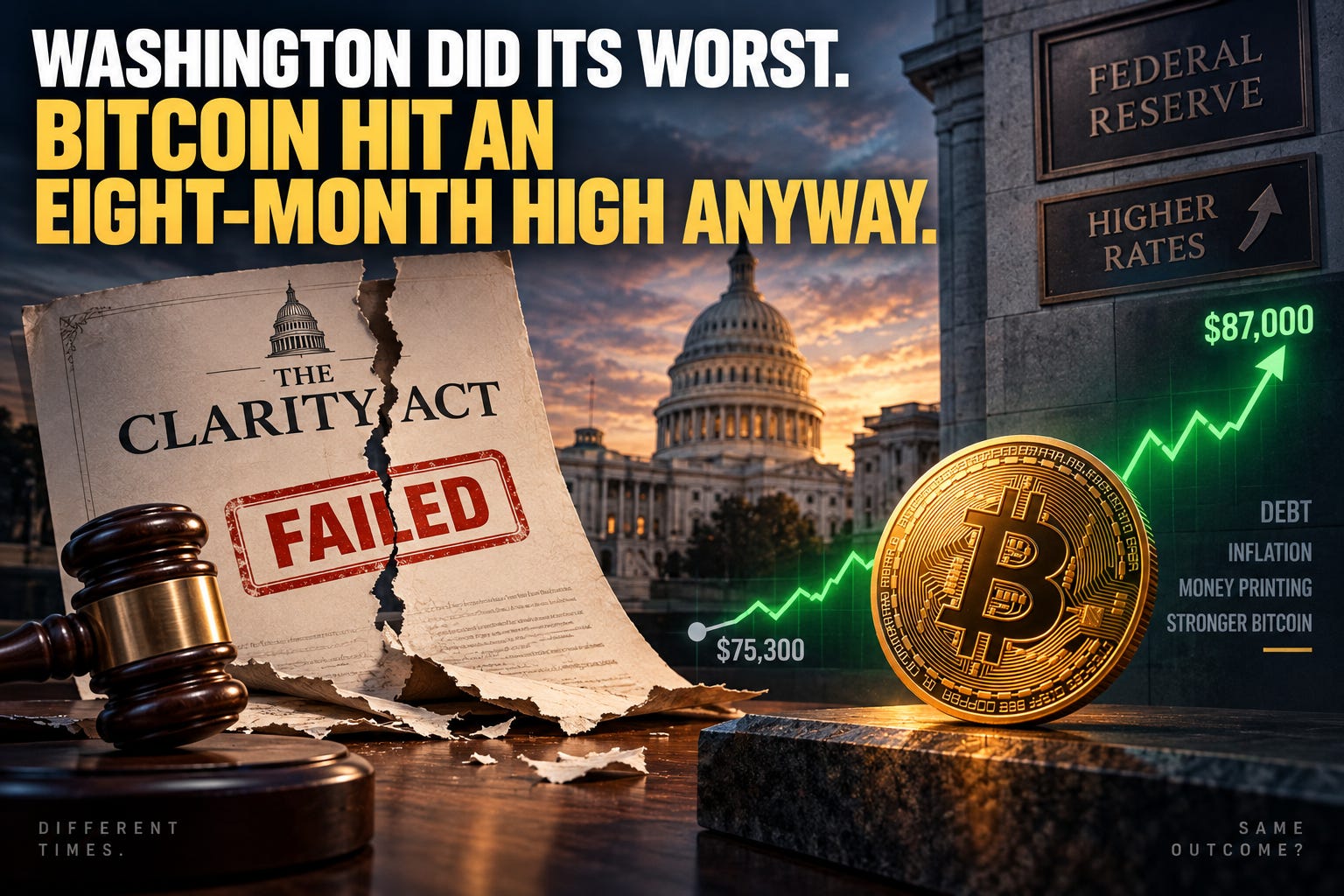
Because the market has stopped reading higher interest rates the old way. In the same seven days that the Senate killed the Clarity Act and the Federal Reserve raised rates, Bitcoin went from a low of around $75,300 to above $87,000, its highest level in eight months. That is the opposite of what the textbook says should happen.
Traditionally, when interest rates go up, money leaves assets like Bitcoin and heads for savings accounts and government bonds, because they suddenly pay a better return for less risk. When rates come down, that money flows back out looking for something better. This week, the market did the reverse, and the reason is the size of America’s debt.
The US government now owes around $40 trillion, more than 120% of everything its economy produces in a year, and it already spends more on interest than it does on its military. A large share of that debt has to be refinanced over the next few years. Britain is not far behind either, with net debt close to £3 trillion, around 94% of GDP, and a record interest bill for the month of August. Every rate rise makes that refinancing more expensive. A higher interest rate is no longer just a better return for savers. It is a bigger interest bill for the government, and there is really only one politically painless way to pay it: create more money.
That is what the market appears to be pricing in. More money printing means each dollar buys a little less over time, which is what people mean by debasement. Faced with that, capital moves towards things that cannot simply be printed. Gold has played that role for a century, and in recent weeks Bitcoin has been tracking gold more closely than it has tracked tech stocks. Bitcoin, with a supply permanently capped at 21 million coins, is increasingly being treated the same way. We saw the first sign of this a few weeks ago when the Treasury quietly started buying back its own bonds. This week, the Fed raising rates pushed the same way.
The Fed is in a genuinely difficult position. It is trying to bring down inflation, protect a slowing jobs market, and keep the government’s borrowing costs under control, all at once, with essentially one lever to pull. Raise rates and the debt bill grows. Cut rates and inflation gets worse. Either path points to more money being created down the line. If that reading is right, Bitcoin is set to benefit whichever way the Fed moves next.
Oil still played a supporting role. Crude fell for four sessions in a row ahead of this Thursday’s summit between President Trump and President Xi, and that helped trigger the sharpest part of the move on Monday. But falling oil explains the timing. The debt problem explains the direction.
The Week Started Badly, at Least on Paper
As we covered in detail last week, the Clarity Act failed its Senate test 49 to 50 on September 15, needing 60 votes to move forward. Bitcoin dipped to around $75,300 on the day and Coinbase shares fell almost 7%, but the dip did not last, and there is a good reason for that. The market had largely priced the failure in already. The day before the vote, betting markets gave the bill only about a 17% chance of becoming law this year.
More importantly, the regulators had already told everyone what would happen next. In a speech on September 14, SEC Chair Paul Atkins urged Congress to pass the bill, then made clear it would not matter much if they did not: “with or without that legislation, this administration will deliver.” He laid out the SEC’s own rulemaking programme, including a new framework for how crypto projects can legally raise money, and the CFTC made a similar commitment. In other words, much of what the Clarity Act was meant to deliver is coming anyway, through the regulators rather than through Congress. The main difference is durability, since agency rules can be undone by a future administration far more easily than a law can. Senator Tillis’s motion to reconsider technically keeps the bill alive, but with the midterm elections on November 3, most observers see it as finished for 2026. Michael Saylor had the best one-line response of the day: “The only clarity you need is Bitcoin.”
The next day, the Fed raised its main interest rate by a quarter of a percentage point, to a range of 3.75% to 4.00%. It was the first increase since 2023, and all twelve voting members agreed. Inflation is still running at 3.4%, and the Fed’s own projections point to one more rise before the end of the year. The yield on a ten-year US government bond is now above 5%, which is exactly the kind of number that makes the government’s refinancing bill so uncomfortable.
So the first piece of bad news was mostly expected, and the second one the market treated as a reason to buy.
How Much of the Rally Was Real?
The big move came on Monday, September 21, when Bitcoin jumped about 7% in a single day. Some of that was forced buying. Traders who had bet on the price falling were caught out, and around $710 million of leveraged positions were automatically closed in 24 hours. Roughly 86% of those were bets against Bitcoin. When those traders are forced out, they have to buy Bitcoin back, which pushes the price up even further. That kind of move tends to fade once the forced buying is done.
The other half of the story is harder to dismiss. US Bitcoin ETFs, the funds that let ordinary investors and pension managers buy Bitcoin through a normal brokerage account, took in $999 million on that same Monday. That was the biggest single day since October last year, led by BlackRock’s IBIT fund. Nobody forces that money in. It is people choosing to buy.
There was also a milestone for anyone who follows charts. Bitcoin closed a week above its 50-week moving average, which is simply the average price over the past year, for the first time in 45 weeks. Galaxy Research pointed out that on 11 of the 13 previous occasions this happened, Bitcoin did not go on to make new lows. It is not a guarantee of anything, but historically it has been a sign that the worst of a downturn is over. Bitcoin is still about 32% below its all-time high of $126,198 from last October.
A Word of Caution About Extreme Greed
The Crypto Fear and Greed Index, a simple daily gauge of market mood, jumped to 78 this week, which counts as Extreme Greed. A month ago it was stuck in Fear. That is a remarkably fast change of heart for a market that just lost its biggest piece of legislation and got a rate rise in the same week.
Underneath the excitement, some of the steadier signals are still soft. Public companies have almost completely stopped buying Bitcoin. Stablecoin supply, a rough measure of how much fresh money is waiting on the sidelines, has barely moved. Extreme Greed sitting on top of a lot of borrowed money has often come shortly before a sharp pullback. None of that means the rally is over. It does mean this is a moment to be a little more careful, not less.
Strategy Is Now Buying Almost Alone
Michael Saylor’s Strategy bought again this week, 950 Bitcoin for about $75.7 million, paid for out of its cash reserves rather than by selling new shares. It now holds 846,000 Bitcoin. Saylor announced it with his usual “A little more orange.”
The bigger story is who is not buying. CoinDesk reported that all public companies combined bought only around 5,900 Bitcoin over the past three months. In the same period a year ago, they bought more than 100,000. The corporate buying spree that helped drive Bitcoin’s rise through 2024 and 2025 has almost entirely stopped, and this week’s rally happened without it.
With Congress Out, Regulators Step In
The SEC wasted no time proving Atkins meant it. Two days after the vote, it granted a five-year exemption allowing new platforms to trade tokenised versions of real company shares on a blockchain, without registering as a traditional stock exchange. Holders keep their full dividend and voting rights. It is exactly the kind of step Atkins promised, and the clearest sign yet that the regulators, not Congress, are now setting the pace.
There was one genuinely good piece of news from Congress too. A House committee approved the Digital Asset Tax Certainty Act by 38 votes to 5, a rare bipartisan result. Its most important feature for everyday users is a de minimis exemption, meaning small transactions would no longer trigger a tax calculation. Right now, buying a coffee with Bitcoin technically creates a taxable event. The IRS received hundreds of millions of tax forms last year, many of them for transactions under $10. This is now the most realistic crypto bill still moving in Washington, and the one most likely to make Bitcoin usable as money day to day.
Meanwhile in the UK
The Financial Conduct Authority published its guidance on which crypto businesses will need to be authorised under the new UK regime, covering trading platforms, custody, stablecoin issuance and staking. Applications open on September 30, and the full regime takes effect on October 25, 2027. While America argues, the UK now has a clear timeline, and so does anyone who wants to run a crypto business there legally.
Quick Hits
Binance faces a new sanctions probe. Bloomberg reported that US prosecutors are examining whether Binance knowingly allowed trading that broke Iran sanctions. Separately, the Justice Department moved to seize $61 million in crypto it says came from black-market Iranian oil sales routed through Binance accounts. Binance is still bound by its 2023 plea deal, so new charges could be serious. The exchange says it has zero tolerance for sanctions violations.
Another reminder about custodial wallets. An attacker drained a few dozen accounts at Blink, a Bitcoin Lightning wallet, on September 19. Only custodial accounts were hit, the kind where Blink held the keys on the user’s behalf. Users holding their own keys were not affected. It comes just two weeks after the $320 million Liquid Network exploit we covered, and it makes the same point again: if someone else holds your keys, their security problem becomes your security problem.
The Trump and Xi summit lands this Thursday, and oil is the number to watch. I will cover what it means for Bitcoin next week. Make sure you are subscribed.
And Finally…
A Robot Out-Robbed a Robber
On September 15, a thief drained $7.8 million from an Ethereum wallet. Before the stolen funds could land, an automated trading bot named “Yoink” spotted the transaction, paid around $47,000 in fees to jump the queue, and grabbed the money first. Somewhere, a hacker is discovering that crime is a very competitive industry.
The 8,000x Rally That Lasted Exactly Long Enough
Two days later, an attacker on a lending platform called Nostra pushed the listed price of an obscure token from less than a cent to $49.50, a rise of roughly 8,000 times. It held that price for precisely as long as it took to borrow against it. If anyone asks what “price manipulation” means, this is the cleanest example you will find all year.
Quick Questions
Q: Why would Bitcoin go up when the Fed raises interest rates?
A: Because higher rates make America’s huge debt more expensive to refinance, and the market expects that bill to be paid with newly created money. More money printing means the dollar loses value over time, which pushes investors towards assets with a fixed supply, like Bitcoin.
Q: Is the Clarity Act completely dead now?
A: Almost certainly for this year. A procedural motion technically keeps it alive, but with the midterms on November 3, a vote before the new year looks unlikely. The SEC and CFTC are now filling the gap with their own rules.
Q: Does Extreme Greed mean I should sell?
A: Not by itself. It is a mood reading, not a prediction. It does mean the market is excited and heavily borrowed, which has often come before sharp but temporary drops, so it is a good moment to make sure you are comfortable with your position.
This article is for information only, not financial advice.