


Why Did Bitcoin’s Rally Suddenly Stall?
We told you last week that Bitcoin’s biggest weekly gain in history was really a reaction to the US Treasury quietly stepping in to manage its own borrowing costs, a signal that markets read as a sign easier money was on the way. That assumption held for exactly one week.
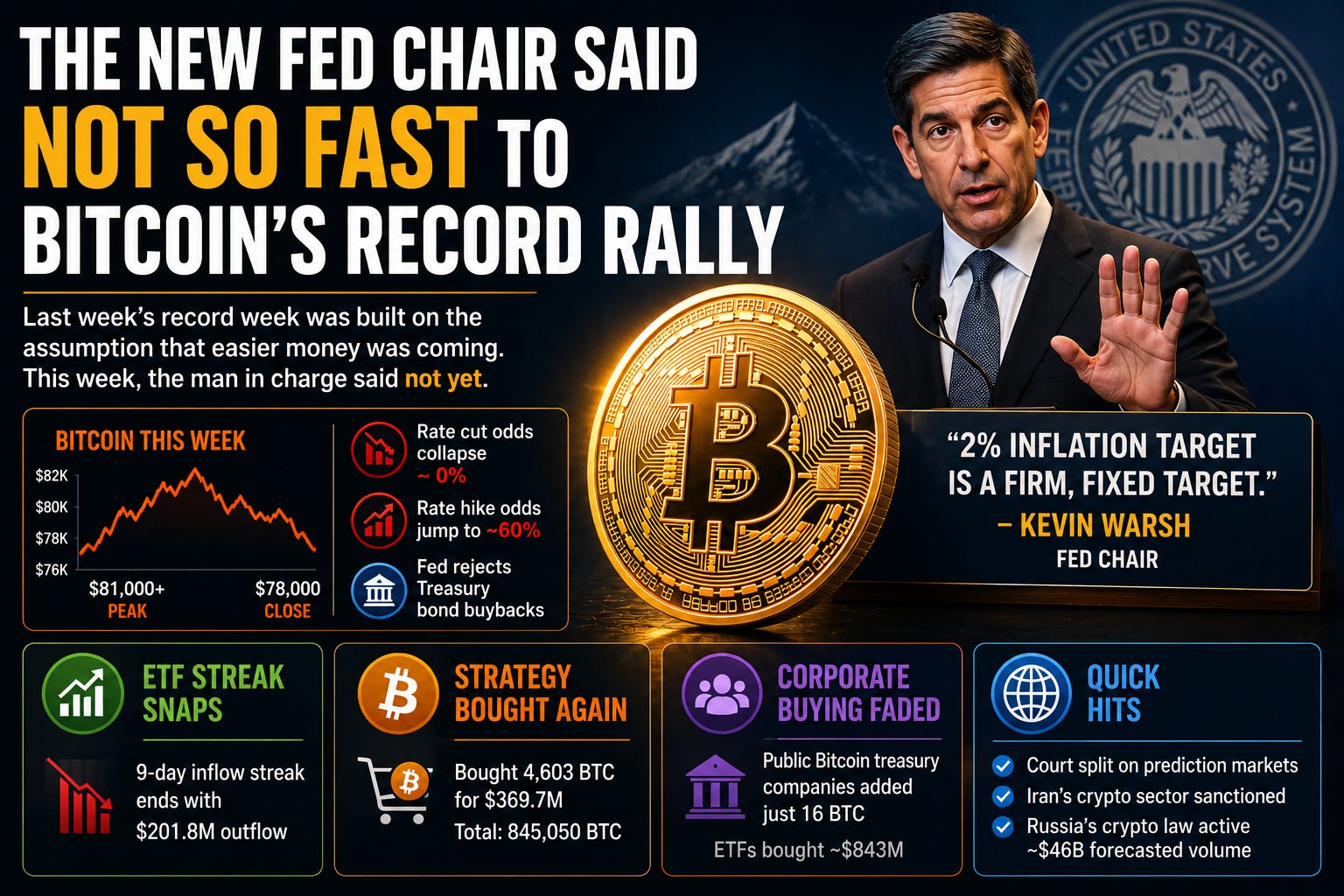
On August 28, new Fed Chair Kevin Warsh gave his first major speech since taking the job, at the Fed’s annual Jackson Hole gathering. He said the 2% inflation target is “a firm, fixed target,” and with inflation still running at 3.7%, the Fed has “work to do.” Just as pointedly, he declined to endorse the Treasury’s bond buyback programme, the exact mechanism that had powered the rally we wrote about last week. Markets took the hint. Odds of a rate cut in September, which had been the working assumption, collapsed to almost nothing. Odds of a rate hike instead jumped from around 41% to roughly 60% in a matter of days.
Bitcoin, which had run from around $62,000 to above $81,000 on the back of that liquidity story, gave back ground and closed the week near $78,000. Crypto-related shares fell harder. Strategy’s stock dropped 6.5% on the day, Coinbase 5.4%. Until the Fed meets again on September 16, Bitcoin is trading the Fed’s next move, not much else.
The Streak That Broke on the Same Day
US Bitcoin ETFs had just put together their best run of the year, nine straight days of inflows worth roughly $2.8 billion, pushing August to more than $3 billion overall, the strongest month of 2026. That streak snapped the same day Warsh spoke, with $201.8 million pulled out in a single day. Buying resumed within a few days, but the timing was not a coincidence.
One detail is worth knowing if you are trying to gauge how broad this demand really is. Roughly 72% of that entire nine-day streak went into a single fund, BlackRock’s IBIT. When almost three quarters of the buying comes from one place, “ETF demand” and “IBIT demand” are close to being the same sentence. It does not make the demand less real. It does mean the story is less diversified than the headline number suggests.
Strategy Bought Again. The Bigger Story Is How.
Michael Saylor’s Strategy ended its ten-week pause this week, the one we covered when the company built a cash pile instead of buying the dip. It bought 4,603 Bitcoin for $369.7 million, taking its total holdings to 845,050 coins, worth roughly $66 billion and more than 4% of every Bitcoin that will ever exist. Saylor marked the return on social media with his usual line about painting the bears orange.
The purchase is the headline. The mechanism behind it is the part worth understanding. Strategy funds its Bitcoin buying by issuing new shares, and that only benefits existing shareholders when those shares trade meaningfully above the value of the Bitcoin the company actually holds. Back in 2024 and 2025, that premium regularly ran at two to three times the underlying value. This week it had compressed to just 1.03 times, essentially at parity. The engine that has driven Strategy’s buying for years is running on fumes, not because Saylor has changed his mind, but because the market is no longer willing to pay much of a premium for what the company does.
Zoom out further and the picture gets starker. Across every publicly listed Bitcoin treasury company combined, including Strategy’s own purchase, the entire sector added a net 16 Bitcoin this week. ETFs alone bought roughly $843 million worth over the same period. The buying that once came from ambitious public companies has almost entirely shifted to passive funds instead.
Quick Hits
A US court just complicated who regulates crypto prediction markets. A federal appeals court ruled that Nevada’s state gambling laws can apply to Kalshi’s prediction markets, rejecting the argument that federal commodities law alone should govern them everywhere. A regulator spokesperson admitted this creates a split between courts that likely needs the Supreme Court to resolve. The same underlying question, whether one federal regulator or fifty separate state regimes should govern crypto-adjacent products, sits underneath plenty of other crypto derivatives too.
Iran’s entire crypto sector is now a sanctions target. We told you two weeks ago that Iran-linked crypto activity was drawing sanctions. This week the US went further, formally naming Iran’s digital asset sector itself as sanctionable, the first time any country’s crypto industry has been designated that way as a whole. Around 60 people, companies and vessels were sanctioned at the same time. In practice, this means any exchange or broker anywhere in the world doing meaningful business with Iranian crypto platforms now risks US sanctions too, not just people dealing with specific named individuals.
Russia’s new crypto law officially took effect. The law Russia signed earlier this summer came into force this week, legalising regulated Bitcoin, Ether and USDT trading while keeping a ban on using crypto to actually pay for goods. Russia’s largest bank, state-controlled Sberbank, is forecasting around $46 billion of regulated trading volume in the first year alone, and plans to offer loans secured against Bitcoin pending approval. A sanctioned economy building a supervised path into Bitcoin, in the same fortnight the US widened sanctions on Iran’s crypto sector, tells you plenty about how unevenly this technology is being treated around the world.
The UK published its first real numbers on crypto wealth. Britain’s tax authority revealed that 17,600 people declared a combined £1.38 billion in crypto gains for the 2024 to 2025 tax year. Just 240 of those people accounted for £717 million of it, over half the entire total. If you are wondering who capital gains reporting rules like this are really designed to catch, that concentration is your answer. Separately, the UK plans to give the Bank of England a formal mandate to support innovation in stablecoins, a genuine shift in tone from a regulator that has been openly cautious about the sector.
Another Blockchain Hit Undo
An attacker manipulated the price of a token used as loan collateral on Crypto.com’s Cronos network, inflating it roughly a hundredfold in twenty minutes before borrowing heavily against it and draining about $74 million. The response was the notable part. Validators halted the entire network and rewound it back to before the attack happened, effectively deleting the exploit from history. It is the same manoeuvre we wrote about a few weeks ago when Ravencoin and Harmony did something similar. A network able to vote to rewrite its own recent past is a fundamentally different kind of system to Bitcoin, where no such vote is even possible. Two smaller platforms, Moonwell and More Markets, suffered nearly identical collateral manipulation attacks in the same week, which suggests this is a pattern other projects need to fix, not a one-off.
The next Fed decision lands September 16, and the Clarity Act’s Senate vote is scheduled for September 15, one day before it. I’ll cover both the moment there is real news. Make sure you’re subscribed.
And Finally…
George Santos Bet on Whether He Would Show Up. Then Tried to Fix the Result.
Prediction market Kalshi handed out the first lifetime ban in its history this week, to former congressman George Santos. He had placed a bet on a market asking whether he would attend the State of the Union, then made public statements, some of them reportedly false, apparently designed to move the price of a market whose outcome only he controlled. He made just under $18,000 doing it and was fined roughly $71,000. Somehow, betting on your own future behaviour and then trying to influence it counts as market manipulation rather than just having a plan.
A Billionaire Asked a Chatbot for Relationship Advice. It Did Not Go Well.
Crypto entrepreneur Justin Sun published a 10,000-word account this week alleging a dispute over a surrogacy arrangement, revealing along the way that he had consulted an AI chatbot for advice, followed its recommendation, and afterwards admitted he was still not entirely sure the AI had been right. The other party denied the entire story, and Sun later suggested parts of his own account may have been fictional. Even by crypto’s standards, that is an unusually honest way to describe taking relationship advice from a chatbot.
Quick Questions
Q: Did Bitcoin actually fall this week, or just stop rising?
A: Mostly the second. Bitcoin gave back some of its gains after touching above $81,000, closing the week near $78,000, roughly flat overall rather than down sharply.
Q: Does Strategy’s mNAV compressing to 1.03 mean the company is in trouble?
A: Not in any immediate sense, it still holds over 845,000 Bitcoin. It does mean the specific method Strategy uses to fund new purchases, issuing shares at a premium, has far less room to work with than it used to.
Q: Should I be worried about Bitcoin after a network rollback like Cronos?
A: No, that happened on a completely different network with a different design, not on Bitcoin itself. Bitcoin has never had a rollback like this in its history, and its rules make one essentially impossible.