


What Actually Happened Today
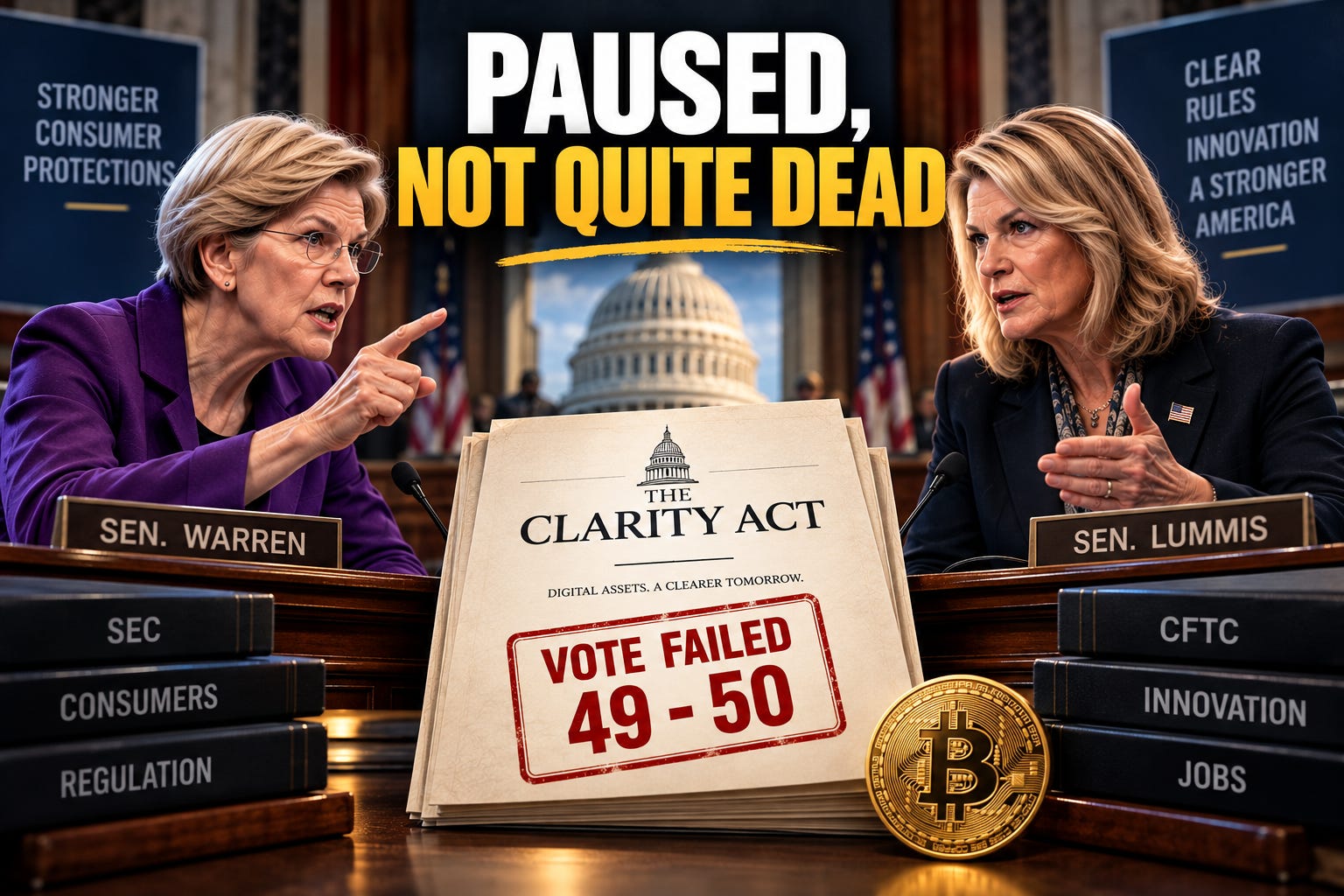
At 2:15pm Eastern time, the Senate voted on whether to invoke cloture, the procedure needed to end debate and formally take up the Clarity Act. It needed 60 votes. It got 49. Fifty senators voted no, and one, Chris Coons, did not vote at all.
Here is the part that makes this genuinely unusual. Senator Thom Tillis, a Republican, had said that very morning he planned to vote yes, calling himself “very pleased” with the ethics provisions the White House had agreed to. When voting opened, he did exactly that. It was only right at the end, once he could see how the tally was actually going to land, that Tillis switched his own vote from yes to no, and immediately filed a motion to reconsider.
That is only possible because of a quirk in Senate rules. Only a senator on the winning side of a vote is allowed to later force a revote. With cloture on track to fail regardless of what he did, “no” was about to become the winning side. Tillis waited to see that outcome confirmed, then deliberately switched himself onto it in the closing moments, purely to preserve the right to bring the exact same vote back to the floor later, without having to file anything new or wait through another round of procedure. Senate leadership can call that motion up again whenever it judges the numbers have shifted, with only a simple majority needed to do so.
Worth noting who did not do this. Collins, Hawley and Moran, the three other Republicans who voted no, had no apparent interest in reconsidering anything, they opposed the bill on its own merits and stayed there. Only Tillis was positioned, and willing, to make this move, which is exactly the kind of thing that has the hallmarks of a contingency plan worked out in advance rather than something improvised in the final seconds. Knowing you might need to flip your own vote at the exact right moment, and being ready to do it the instant the count allows, is not really something you figure out on the fly.
So this is not quite the ending it looks like. The bill is not dead. Senate leadership can bring Tillis’s motion back up whenever it judges the numbers have shifted, needing only a simple majority and no fresh filing, with no deadline forcing its hand either way.
Reactions to what happens next span the full range. One Republican Senate aide told The Block flatly that they think the bill is dead. Tillis himself posted that “this is not the end,” crediting the White House for “substantial bipartisan progress.” Senator Ted Cruz put it as there being “a big difference between dead and mostly dead.” Senator John Kennedy suggested the more realistic path might be the lame-duck session after November’s midterm elections rather than anything sooner. Democrats who voted no, including Senator Alsobrooks, insist the bill is not dead either, while blaming Republican leadership for forcing a vote before the last disputes were actually resolved.
There is a real precedent for reading this as temporary rather than final. A similar cloture vote on stablecoin legislation failed in the Senate last year, only for that bill to become law anyway once negotiators went back to the table. Anchorage’s Kevin Wysocki drew exactly that comparison today, suggesting several of the senators who voted no were closer to yes than the headline number suggests. What happens in the meantime is likely more of what has defined this bill for over a year: closed-door negotiation rather than public floor action, until either leadership senses the votes have shifted, or the political window closes as election season pressure builds.
What the Clarity Act Would Actually Do
It is worth being clear about what was actually on the table, because the fight over ethics language has crowded out the substance for most of this year.
Right now, American crypto companies operate without a clear rulebook. The SEC has claimed jurisdiction over most tokens as unregistered securities. The CFTC has claimed Bitcoin and Ethereum as commodities. Courts have ruled inconsistently. Nobody launching a new project or running an exchange can say with certainty which regulator they answer to, or what the rules actually are, because the rules mostly exist as scattered enforcement actions and case law rather than a single statute.
The Clarity Act would have replaced that with an actual system. It creates three categories: securities, which stay with the SEC, digital commodities, which move to the CFTC, and payment stablecoins, which fall under banking regulators. Bitcoin and Ethereum would be explicitly written into law as digital commodities, not just treated that way by regulatory guidance that a future administration could quietly reverse. Exchanges and brokers dealing in digital commodities would register with the CFTC rather than operating in the grey area they do today. Newer, smaller tokens get a defined path to eventually be treated as decentralised commodities too, once they genuinely stop being controlled by a small founding team.
That last point is what “clarity” actually means in practice. A company building a new product would know on day one which regulator it answers to, what disclosures it owes, and what it is allowed to do, rather than finding out years later through an enforcement lawsuit. For Bitcoin specifically, its commodity status would move from something regulators currently say to something federal law says, which is a meaningfully more permanent form of protection.
What Democrats Actually Wanted, and What They Got
The single biggest obstacle all year has been what to do about President Trump’s own crypto income, reported at $1.4 billion in 2025, along with his family’s involvement in World Liberty Financial and its stablecoin, USD1. It is worth going through this properly, point by point, because both sides have spent the week citing the same negotiation and reaching opposite conclusions about it.
The starting position in July was narrow. It barred federal officials and their spouses, specifically, from issuing or sponsoring a digital asset for compensation while in office. It was enforced only by the Justice Department, an agency that ultimately answers to the president. And the whole provision was set to expire in January 2029, conveniently around the same time Trump’s own term ends. Democrats had three specific, named objections to that version: enforcement sat entirely with the president’s own appointees, the rule only covered issuing or sponsoring an asset directly and said nothing about simply holding a stake in a company that profits from one, and it did not reach any family member beyond a spouse, which left adult children directly involved in running businesses like World Liberty Financial completely untouched.
Senators Thom Tillis, a Republican, and Ruben Gallego, a Democrat, spent the rest of the summer building a bipartisan fix aimed at exactly those three complaints. Here is what actually changed in the text that reached the floor this week, matched against each one.
On enforcement sitting entirely with the president’s own appointees: partially fixed, and it is worth being precise about what that actually means. The final text does add a genuinely new state attorney general channel. A state AG who can show the state or its residents were harmed, including financial harm over $100, gets standing to sue in federal court seeking injunctive relief. But that channel comes with a built-in limit: no such case may be brought at all if the covered official’s own supervising ethics office, the Office of Government Ethics for a sitting president, has already issued a legal opinion that the activity is not prohibited. The same administration whose official is under scrutiny gets to close the door before a state ever gets through it. Worth noting a separate, older clause exists elsewhere in the bill preserving state consumer protection law generally, but it applies to exchanges and issuers in the broader market, not to this specific ban on officials, and does not offer any way around the limit above. More on that distinction shortly.
On the rule only covering issuing or sponsoring, not holding a stake: fixed. The final text adds a distinct ban on simply holding what it calls a “significant financial interest,” an equity stake worth $15,000 or more, adjusted for inflation, in a business that gets the largest share of its revenue from issuing or sponsoring digital assets over the preceding three years. Anyone over that threshold must divest the stake or place it in a qualified blind trust. That test is squarely aimed at exactly the kind of arrangement World Liberty Financial represents, and it comes with real teeth: civil penalties of 20% of the value involved or $500,000, whichever is larger.
On reaching family members beyond a spouse: unresolved, and this one is a genuine disagreement rather than a simple fix that got missed. The final text still only covers the official and their spouse. Trump’s adult sons, who run World Liberty Financial, remain entirely outside its scope. Democrats see that as a loophole, since a family business can act as a convenient channel for the same money.
But there is a real argument on the other side too: adult children are legally independent people who never sought or held office themselves, and writing a law that restricts what they can do for a living purely because of who their father is would be an unusual and fairly significant step, one with no real precedent.
Hunter Biden faced plenty of political controversy over his business dealings while his father was vice president and then president, but no law ever restricted what he was allowed to do. Historically, this kind of thing has been handled through disclosure and political pressure, not legal restriction on someone who is not themselves a public official. Worth flagging the irony given what he was doing this same week, see And Finally below.
Put plainly, of the three named complaints, one was genuinely and fully fixed: the expansion to cover holding a stake, not just directly issuing or sponsoring an asset. A second, enforcement, was addressed on paper but comes with a built-in limit that undercuts it considerably, as the next section shows in detail. The family-member gap is the one that remains straightforwardly unresolved. Senator Lummis’s office counted 126 separate changes made at Democratic request across the whole bill, and the ethics title accounts for a meaningful share of that activity, but the headline claim that the single toughest complaint, who can actually hold anyone accountable, was solved does not fully survive contact with the bill’s own text.
Here is the point worth sitting with regardless of where you land on that judgment call. None of this, not the direct-holding rule, not any enforcement mechanism, exists in law today. Current federal law contains no crypto-specific ethics restriction on elected officials at all. A no vote does not preserve some stronger, alternative version of these protections. It preserves nothing. Whatever you think should happen about family members, that question remains completely open either way, and the one genuine improvement both sides could point to also disappears. Trump, his sons, and any future official and their family members remain completely free, right now, to do everything both the imperfect new rule and the current total absence of any rule would allow, because as of today, the current absence of any rule is the only one in effect.
Fact Check: Did the Bill Really Double in Size?
Senator Lummis and her co-sponsors have repeatedly said the final bill reflects well over 100 Democrat-requested changes, with the official number settling at 126. That claim holds up. Two entirely new titles covering illicit finance, containing more than 20 sections between them, were added specifically at Democratic request. The DeFi safe harbor provision alone grew from 285 words in an earlier draft to roughly 2,200 words in the final text, adding detailed carve-outs and registration triggers that were not there before.
The “doubled in size” claim also checks out, depending on which starting point you use. The version that cleared the Senate Banking Committee in May ran 309 pages. The final text released the night before the vote runs 635 pages, almost exactly double. Some of that growth is genuinely bipartisan technical detail rather than pure concession to either side, but the scale of it is real, not exaggerated.
One change worth noting on its own: earlier drafts of the ethics title, including the one the White House originally proposed back in July, included a sunset clause that would have ended the entire ethics ban at noon on January 20, 2029, inauguration day. Democrats objected to that timing specifically, since it meant no enforcement could survive past the end of Trump’s own term for conduct that happened during it. The final text drops the sunset section entirely. Whatever else changed in the ethics title between drafts, that particular objection was actually resolved.
The specific claim that the bill is now “more Democrat text than Republican text” has since been made directly, on the record. In her floor speech today, Lummis said plainly: “Democrats secured 126 separate concessions in this text, and they wrote more than half of the 630 pages in front of you.” That is her own characterisation, not an independent audit, and nobody has published a clean word count broken down by which party actually drafted which section to verify it. What can be said with confidence is that a very large share of everything added since May, the illicit finance titles, the expanded DeFi provisions, and the ethics language, exists specifically because Democrats asked for it.
How the Vote Broke Down
The maths ends up remarkably clean once you see it laid out. Republicans hold 53 seats. Four of them voted no: Susan Collins, Josh Hawley, Jerry Moran, and Thom Tillis, whose no vote was tactical rather than a genuine objection. That leaves exactly 49 Republican yes votes, and not a single Democrat crossed over to join them, despite two Democrats, Ruben Gallego and Angela Alsobrooks, having voted for the bill back when it passed committee in May. Every Democrat and independent who cast a vote today voted no. Chris Coons did not vote.
That is worth sitting with. A year of negotiation, 126 tracked concessions to Democratic demands, a bill that doubled in size largely to accommodate those demands, direct engagement from the White House, and the final vote still fell on almost perfectly straight party lines. Whatever else this says about the bill itself, it says something fairly stark about the current political environment surrounding it.
Does Senator Warren’s Objection Actually Hold Up?
Senator Elizabeth Warren gave the most prominent speech against the bill, calling the ethics provisions a “weak fig leaf” that would do nothing to stop Trump from making his “next $1.4 billion in crypto profits.” Her strongest specific claim was that Trump could keep profiting through World Liberty Financial regardless of what the bill says, since his sons run the business and are not covered by the spouse-only language, exactly the unresolved gap discussed above.
Warren also raised a specific example worth naming directly: she said the bill does nothing to stop Trump from becoming “the first president in American history to own and regulate his own bank,” a reference to World Liberty Financial’s trust bank charter application with the Office of the Comptroller of the Currency. Whether that charter application succeeds is a live regulatory process separate from the Clarity Act itself, but her broader point, that owning both a crypto business and influence over the regulators overseeing banking, stands regardless of how this specific bill’s ethics title turns out.
Here is where the two senators stopped simply disagreeing in tone and started making testably different claims about the same provision. Warren said, on the floor: “The bill would not allow state attorneys general to bring any enforcement actions against the president. All they could do is try to sue Trump’s former personal lawyer, the attorney general.” Lummis said: “State attorneys general now have direct authority to enforce these ethics rules against federal officials themselves.” Warren also made a second, sharper claim worth testing on its own: that Trump’s “handpicked cronies at his Office of Government Ethics can wave a magic wand by issuing a legal opinion” to protect him from enforcement.
The actual final bill text, released the night before the vote, resolves both claims more precisely than either soundbite. It does create a new state attorney general channel that did not exist in earlier drafts. A state AG who can show the state or its residents were harmed, including financial harm over $100, gets standing to sue in federal court seeking an order compelling action, with an unusually fast-tracked process attached: a district court finds the facts, but the actual ruling goes straight to the full circuit court of appeals sitting en banc, which reviews those facts fresh rather than deferring to the trial judge, with a direct path to the Supreme Court after that. That is a genuinely serious piece of legal architecture, not something bolted on as an afterthought.
But look at exactly who that lawsuit is against. The text specifies the state attorney general sues the United States Attorney General, not the covered official. That is precisely what Warren described, suing “the attorney general,” not suing the president. And the text adds a second condition on top: no such case may be brought at all if the covered official’s own supervising ethics office, the Office of Government Ethics for a sitting president, has already issued a legal opinion that the activity is not prohibited. That is close to a direct match for Warren’s “wave a magic wand” claim, not rhetorical exaggeration but a fair paraphrase of how section 13153 actually reads.
Lummis was not wrong that state attorneys general got something real out of this negotiation that they did not have in earlier drafts. Where her floor description overstated the case is the word “against.” The authority runs against the US Attorney General, seeking to compel action, not against the federal official directly, and the same administration’s own ethics office holds a key that can lock the whole channel before it is ever used.
Worth being precise about scope, too. A separate, older provision elsewhere in the bill, unrelated to the ethics title entirely, preserves ordinary state consumer protection law and common law remedies against exchanges and issuers generally. That clause is real and gives Lummis’s broader point about states retaining power some genuine footing. It has nothing to do with the officials’ ethics ban specifically, though, and offers no way around the ethics office’s veto on that narrower question. Put the two pieces together and the picture is genuinely asymmetric: ordinary market participants face an unconditional state enforcement backstop with no off switch, while the mechanism aimed at officials themselves comes with one built in.
One more fair point cuts the other way, though. Warren’s reading of that provision was accurate, but it is a reading of a single mechanism inside a 635-page bill, and today’s vote was not on that mechanism in isolation. It was a single yes or no on the entire package, covering market structure, illicit finance rules, developer protections, customer protections, and everything else Division C sits alongside. Being correct about one specific limit on one enforcement mechanism does not, by itself, tell you whether rejecting the whole bill over it was the right call. That is a genuinely separate question from whether the factual claim was accurate, and it is one reasonable people can weigh differently. It is also worth noting this cuts both ways for any large bill: an opponent can always find one accurate criticism of one provision, and a supporter can always point to everything else in the package that criticism leaves out. Neither point resolves the other.
Warren raised a second specific objection to the blind trust remedy itself, arguing Trump “could just put his holdings in a blind trust in name only while still knowing exactly what assets are there.” There is a real, substantive counter available in the bill’s own text. The remedy specified is not a generic or informal “blind trust.” It is explicitly a “qualified blind trust,” defined by cross-reference to the existing federal ethics standard, the same framework created by the Ethics in Government Act of 1978 in the aftermath of Watergate, for the exact purpose Warren is describing. A qualified blind trust requires a genuinely independent trustee, someone with no prior relationship to the official, who cannot be a relative, friend, or associate, and the official is legally barred from communicating with that trustee about specific holdings once it is set up. The bill goes a step further still: once a stake is properly placed in a qualified blind trust, the text states plainly that neither the trustee’s actions nor the actions of any business the trust invests in, including issuing or sponsoring a digital asset, can be attributed back to the official at all. “Knowing exactly what assets are there” is precisely what the legal structure is designed to prevent. Whether that structure gets properly enforced in this specific case is a fair question. Whether the structure itself is meaningless is a different question, and both its history and its text suggest otherwise.
The bigger structural problem with the objection, regardless of how the enforcement dispute resolves, is a simple one, and it is the same point White House crypto adviser Patrick Witt made to the banking industry over a separate dispute this week: if a rule does not go far enough, voting to have no rule at all does not fix that. Right now, before this bill, there is no specific federal law governing how elected officials may or may not profit from crypto ventures while in office. None of what Warren describes as loopholes exists because of the Clarity Act. They exist because no law like this has ever been on the books. Voting no does not close the World Liberty Financial gap she is rightly worried about. It simply leaves that gap, and every other question the bill was trying to answer, completely unaddressed.
Warren has proposed her own alternative, a broader bill called the Ending Presidential Corruption in Banking Act, which would restrict banking licence approvals for the president and other senior officials entirely. It is a genuinely different approach to a real concern. It also has no realistic path through a Republican-controlled Senate any time soon, which means the practical choice today was never between the Clarity Act’s ethics rules and something stronger. It was between the Clarity Act’s ethics rules and nothing.
The Rest of the Week
Away from the Senate floor, the macro picture kept moving. August inflation data came in a touch hot, and that alone was enough to push the odds of a Fed rate hike tomorrow from 60% to over 92% on CME’s tracking tool. Bitcoin held a tight range through it all, trading between roughly $76,500 and $79,600 and closing the week down about 1.2% near $77,000. Oil pushing past $100 a barrel on renewed Iran tensions is doing plenty of the work behind that inflation pressure.
US Bitcoin ETFs lost $462.7 million across four sessions before flipping back to a $159.9 million inflow on Monday, led by BlackRock’s fund, a pattern that looks more like professional investors de-risking ahead of a known event than any real change of heart. Strategy went a second straight week without buying any Bitcoin, instead spending on buying back its own preferred stock, while Strive kept adding and crossed 25,000 Bitcoin in total holdings. KULR Technology sold its last 764 Bitcoin and exited the corporate treasury strategy entirely.
The Liquid Network story we have followed for two weeks is now closed out. Of the roughly 4,000 Bitcoin taken in the original hack, 3,400 has been returned, with the attackers keeping about 598 Bitcoin, worth roughly $46 million, as a self-declared bounty. Ledger’s chief technology officer publicly called that framing closer to extortion than heroism.
Bill text sourced from lummis.senate.gov/wp-content/uploads/EHF26724.pdf, the final substitute released the night before the vote.
Senate leadership can call up Tillis’s motion to reconsider at any point it judges the votes have shifted, and tomorrow’s Fed decision lands regardless. I will cover both the moment there is real news. Make sure you’re subscribed.
And Finally…
Hunter Biden’s Memecoin Crashed 98% in Minutes
Hunter Biden’s memecoin, $LAPTOP, launched this week explicitly aimed at people holding the Trump family’s own token, and collapsed roughly 98% within minutes of listing. One journalist admitted he had handed over 5,000 of his own fans’ email addresses believing he was helping with an unrelated giveaway. Eric Trump’s entire public response was: “Hunter should go back to painting.” Worth noting, given his own name came up earlier as the precedent for why an official’s family members should not be restricted, that this is exactly the kind of family-adjacent crypto cash-in this whole ethics debate is about.
The $245 Million Bitcoin Thief Pleaded Guilty
One update on a story we have already covered in detail: Malone Lam, the 22-year-old behind the $245 million Bitcoin theft whose spending spree included a $569,000 night at a Los Angeles nightclub and cash stashed in a washing machine, pleaded guilty this week to a racketeering conspiracy.
Quick Questions
Q: Is the Clarity Act definitely dead for this year?
A: Not definitely. A motion to reconsider is already filed and can be called up at any point Senate leadership believes it can find the extra votes, though nothing forces that to happen on any particular timeline.
Q: Did any Democrats support the bill in the final vote?
A: No. Despite two Democrats backing it in committee back in May, every Democrat and independent who voted today voted no, even after 126 tracked changes were made to address their concerns.
Q: Does voting against the Clarity Act protect against the ethics concerns Senator Warren raised?
A: No. There is currently no specific federal law governing crypto conflicts of interest for elected officials, so a no vote leaves that gap completely open rather than closing it. The choice was between imperfect new rules and no rules at all, not between imperfect rules and better ones.