


Why Did the US Government Suddenly Start Buying Its Own Bonds Back?
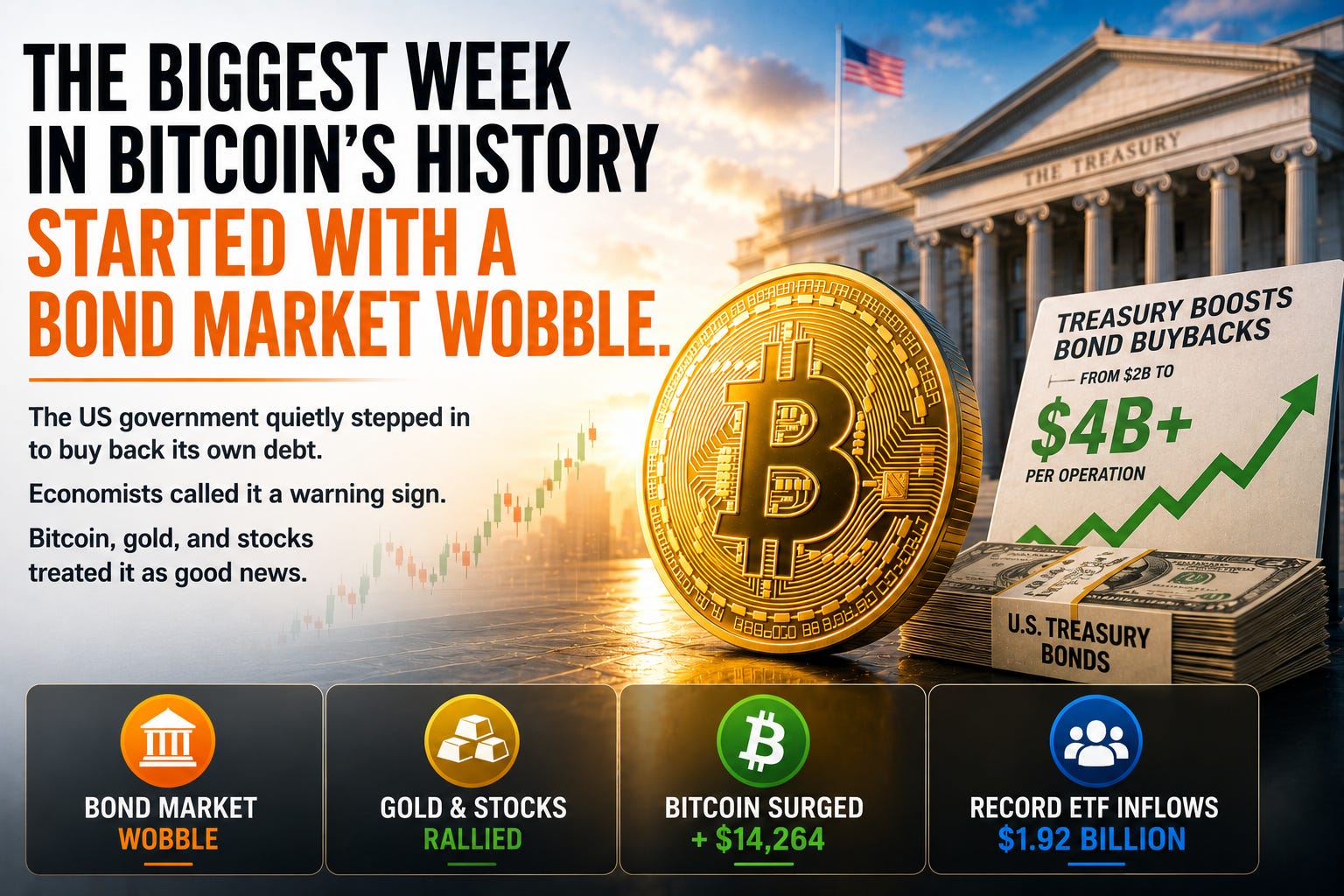
On August 19, the US Treasury announced it would more than double a programme that buys back older government bonds, taking it from $2 billion to at least $4 billion per operation starting in September. The reason: the interest rate on 30-year US government debt had just hit 5.34%, its highest level since 2007, and investors had largely stopped showing up to buy new long-term US debt since late June. When a government cannot sell its debt at a rate it can afford, it has to do something. This was that something.
It worked, in the narrow sense that yields fell within hours of the announcement. It is worth understanding why serious economists are not celebrating it, though.
Why Economists Are Calling This a Warning Sign
Government bonds work like this. The government borrows money for a fixed number of years and pays interest on it. When plenty of investors want to lend the government money, the interest rate stays low. When investors get nervous, either about inflation or about how much debt a government is piling up, they demand a higher rate to compensate, or they simply stop buying. That second scenario, sometimes called a buyers’ strike, is what had been building in the market for 10 to 30-year US bonds since late June.
Faced with that, the Treasury essentially became its own biggest customer. Deutsche Bank’s George Saravelos described the move as a sign of “increasing administration unease” about rising long-term borrowing costs. Economist Mohamed El-Erian went further, calling it an early step toward something known as yield curve control, where a government or central bank directly intervenes to cap its own borrowing costs rather than letting the market set them. Historically, that kind of intervention shows up when a government is struggling to fund itself through ordinary demand, not when everything is running smoothly. President Trump, asked directly whether Americans should be worried, said “No, I don’t think so.” Yields crept back up again within a day of the announcement regardless.
None of this means a crisis is imminent. But it is a genuinely different story to “markets had a great week,” and it is the real reason this week’s Bitcoin rally is worth understanding properly rather than just celebrating.
Why Bitcoin Rallies on Bad News for the Dollar
Here is the connection that matters. When a government has to step in and manage its own debt costs directly, the eventual result tends to be more money printed and looser policy down the line, because that is usually the easier path politically than either raising taxes or cutting spending. That prospect, more dollars chasing the same amount of stuff, tends to push investors towards assets that cannot simply be printed. Gold has played that role for a century. Bitcoin, with a supply permanently capped at 21 million coins, is increasingly playing it too.
That is the real backdrop to Bitcoin gaining $14,264 in a single week, the largest dollar gain in its history, closing at $77,387 and pushing past $80,000 the next day. Worth being honest about scale, though: Bitcoin remains roughly 37% below the all-time high of $126,198 it reached last October. This was a serious recovery from a beaten-down price. It was not a new record.
The Mechanics Behind the Move
Two things happened on top of the bond market signal, and they are worth telling apart because they mean different things.
The first was mechanical. Traders who had bet against Bitcoin were suddenly proven wrong, and exchanges forced them to close those bets automatically. Short sellers lost $2.74 billion in a single day, a record, with more than a billion dollars of positions closed in roughly an hour. Moves like this tend to run out of fuel once the forced buying finishes, because no genuine new demand created it.
The second was not mechanical at all. US Bitcoin ETFs took in $1.92 billion over the week, the strongest week since October last year. That money represents ordinary investors and advisers actively choosing to buy, not being forced to. BlackRock’s IBIT fund alone brought in the majority of it. Between the two, the ETF flows are the more meaningful signal that this rally has genuine substance behind it, not just a squeeze that will fade.
The SEC Finally Showed Its Hand
Away from the bond market, there was a genuine regulatory step forward this week too. The SEC formally proposed Regulation Crypto Assets, giving crypto companies two clear paths to legally raise money from investors. Smaller projects can raise up to $5 million over four years with light paperwork. Larger ones can raise up to $75 million a year if they agree to publish proper financial reports.
The detail that matters most long term is quieter than either number. The rule also stops individual US states from layering their own separate registration requirements on top of federal ones, which has made compliant token sales genuinely impractical for years. SEC Chair Paul Atkins called it a step to help crypto innovation flourish, while admitting a rule made by one SEC can be undone by the next one. That is exactly why the industry keeps pushing for a proper law instead. The very next day, President Trump hosted crypto executives at the White House and publicly pushed Congress to pass the Clarity Act, the bigger bill that would make rules like this permanent.
Meanwhile, Strategy Sat This One Out
Strategy, the company that has spent years building its identity around buying Bitcoin, raised $2 billion this week and put none of it toward Bitcoin. The money went into cash reserves and a preferred stock buyback instead. Its holdings sit exactly where they were, at 840,447 coins. Across August the company has raised $3.28 billion and now sits on $6.69 billion in cash.
There is a real reason behind it. Strategy’s share price currently trades almost exactly in line with the value of its Bitcoin holdings. When shares trade above that value, issuing new shares to buy more Bitcoin makes existing shareholders richer. At parity, it no longer does. Saylor appears to be waiting for that gap to reopen. Strive, a smaller rival, took the opposite approach this week, buying 1,110 Bitcoin while Strategy bought none.
Quick Hits
Iran’s crypto industry is now a sanctioned target. The US Treasury designated nearly 60 people, companies and vessels linked to Iran, and for the first time formally named crypto itself as a sanctionable part of Iran’s economy. That gives US authorities a standing basis to sanction any exchange or platform found helping Iran move money through crypto, anywhere in the world, without building a fresh case each time.
Visa and Mastercard are fighting over stablecoins. Visa is searching for a new partner to handle stablecoin payments after Mastercard bought its previous partner, BVNK, for up to $1.8 billion. Both of the world’s biggest card networks now clearly see moving stablecoins as core business rather than a side experiment.
A DeFi lender lost $8.5 million despite having safeguards. Term Finance, a lending platform built on Ethereum, was drained of roughly $8.5 million through a flaw in its own governance system. The safeguards meant to prevent exactly this, a waiting period and a veto right, both existed and both failed.
The next major catalyst is Kevin Warsh’s first speech as Fed Chair at the Jackson Hole symposium, running August 27 to 29. I’ll cover it the moment there is real news. Make sure you’re subscribed.
And Finally…
An Exchange Banned Its Own Staff From Using Claude
Crypto exchange OKX banned its Hong Kong staff from using Anthropic’s Claude after Anthropic suspended the exchange’s account. The genuinely surprising detail was not the ban itself, it was OKX revealing it spends somewhere between $6 million and $8 million a month on AI tools. That is a lot of chatbot subscriptions for a crypto exchange.
Quick Questions
Q: Why would Bitcoin go up because of a problem in the bond market?
A: Because the usual fix for a government struggling to borrow is to eventually create more money, and that risk of currency debasement is exactly what makes a fixed-supply asset like Bitcoin more attractive to some investors, not less.
Q: Is Bitcoin at a new all-time high?
A: No. Despite the biggest weekly gain in its history, Bitcoin is still roughly 37% below the record of $126,198 it reached in October 2025. This was a strong recovery, not a new peak.
Q: Should I be worried that Strategy did not buy Bitcoin this week?
A: Not especially. The company still holds its full 840,447 Bitcoin unchanged. It has paused new purchases while its own share price sits at a level where buying more would not currently benefit existing shareholders.