


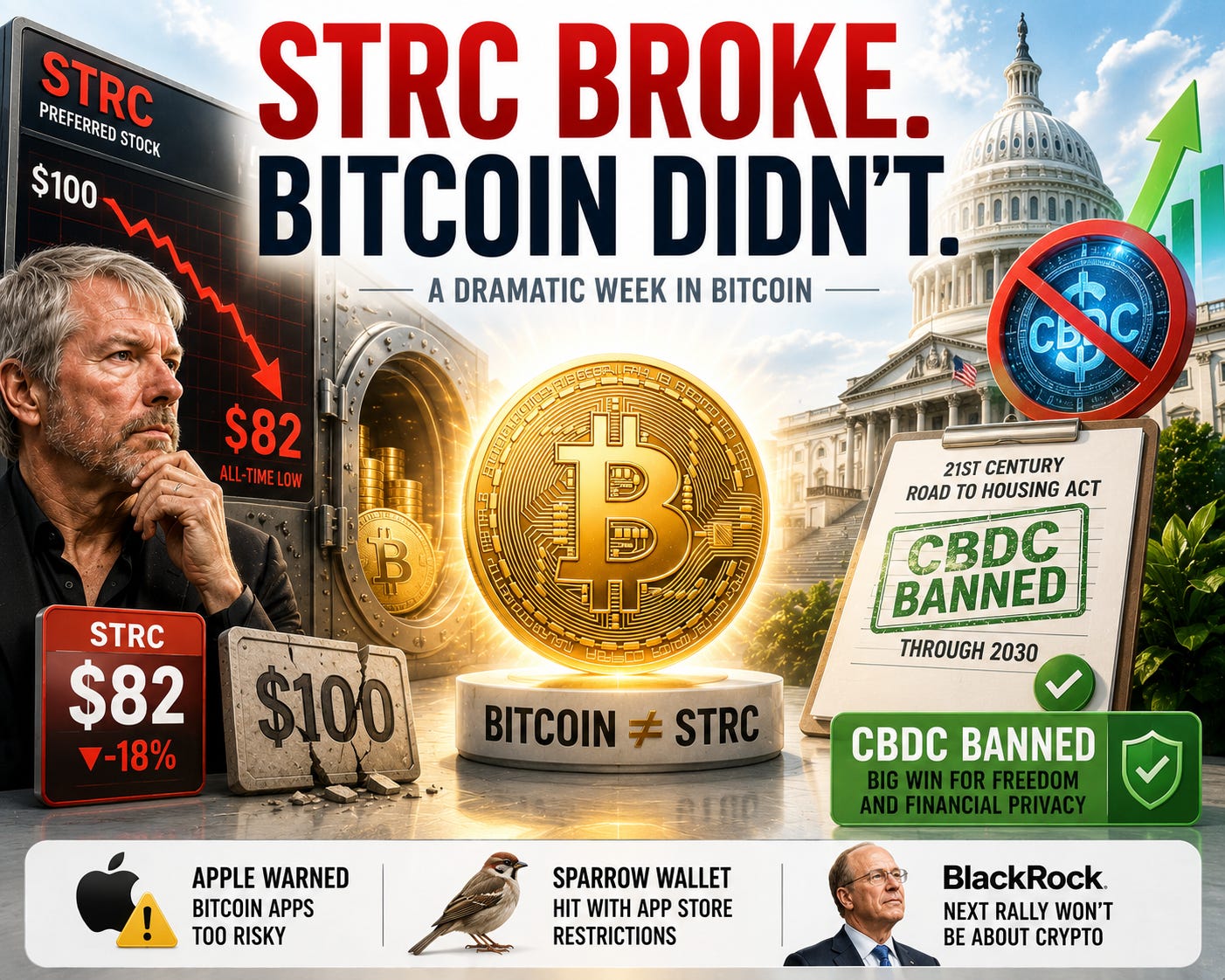
The STRC Story: When ChatGPT Didn’t Model This Scenario
Last week we explained in detail how STRC works — Strategy’s preferred stock product designed to trade at $100 per share and pay an 11.5% annual dividend, with every dollar raised going straight into buying Bitcoin. This week, STRC hit an all-time low of $82.53. For investors who bought at $100 believing the par value was stable, that is a painful and confusing development.
The detail that caught everyone’s attention: Saylor reportedly designed STRC with help from ChatGPT. In a recent interview he described using the AI to engineer the financial structure. Which raises an obvious question — did nobody ask it what happens if Bitcoin drops 50% and your cash reserves run dry at the same time?
Because that is essentially what happened. In May, Strategy used $1.5 billion from its dedicated cash reserve to buy back its own convertible bonds at a discount — sensible housekeeping on paper, but it drained the cushion that was supposed to cover STRC dividends. Coverage fell from 24 months to six. Then Bitcoin slid below $60,000 in early June. CryptoQuant published a formal warning this week saying dividend coverage has since collapsed to just 14 months, cash reserves are down 38%, and annual dividend obligations have quadrupled to $1.2 billion in six months. Their conclusion: Saylor needs to stop buying Bitcoin and rebuild cash.
Strategy currently holds 846,842 Bitcoin at an average cost of $75,656. With Bitcoin at $62,500, that’s an unrealised loss of around $11 billion. Not a crisis in itself — unrealised losses only matter if you’re forced to sell — but enough to rattle markets.
The collapse accelerated for a reason beyond the fundamentals. When STRC first dipped into the $90s, traders spotted what looked like a sure-thing trade. STRC is designed to return to $100. Buy at $95, collect the dividend, sell at $100. Many used leverage to amplify the bet. When STRC kept falling instead of recovering, those leveraged positions got force-liquidated automatically — every sale pushing the price lower, triggering more liquidations, pushing it lower still. A textbook cascade that turned a manageable dip into an 18% collapse.
One can only wonder if Saylor is quietly wishing he’d had access to Claude’s Fable — Anthropic’s most advanced frontier model, which was pulled back because it was simply too smart to release to the public — to stress-test the model before launch. ChatGPT, it seems, didn’t quite run this scenario.
So Why Is SATA Still at $100?
SATA — Strive’s almost identical product, paying 13% — also experienced volatility in mid-June. But it bounced back to par. STRC didn’t. The difference is structural design.
Strive built SATA with an explicit 18-month cash reserve, sized to cover all dividend obligations even through Bitcoin’s worst bear markets. Their CEO pointed to the 2022-2023 crash — when Bitcoin fell from $69,000 to under $16,000 over 18 months — as the stress test benchmark. SATA is engineered to pay through that without selling a single coin. Strategy didn’t maintain the same discipline, and spent down its reserves at the wrong moment.
SATA is currently trading at $99 to $101, raising around $8 million per day in new capital, buying Bitcoin daily. This is not a Bitcoin problem. It is a Strategy-specific problem caused by a specific financial decision. The asset is fine. One product structure had a flaw the market has now found.
The CBDC Ban Nobody Is Talking About
While the STRC drama consumed most of the oxygen this week, something quietly significant happened in the US Senate that deserves more attention than it got.
On June 22, the Senate passed the 21st Century ROAD to Housing Act by 85 votes to 5. It is a bipartisan housing supply bill — the kind of legislation that passes without much fanfare. But buried inside it is a provision that bans the Federal Reserve from issuing a central bank digital currency through December 31, 2030.
In plain English: Congress just made it illegal for the US government to create a digital dollar for the next four years.
A CBDC — central bank digital currency — would be a government-issued digital version of the dollar, where every transaction is visible to the state, and the government could theoretically program money to expire, restrict what it can be spent on, or freeze it entirely. For many Bitcoin holders, it represents the dystopian alternative to everything Bitcoin stands for. And it just got banned.
The reason it matters so much: attaching the ban to a must-pass housing bill dramatically increases the odds it actually becomes law. The House had already passed a standalone Anti-CBDC measure. House Republican leaders have signalled an expedited vote on the Senate-amended bill. This is very close to landing on the President’s desk.
A four-year CBDC moratorium removes a potential government competitor to Bitcoin and private stablecoins. It signals clearly that Congress’s preference is private-sector digital money — which is exactly what the GENIUS Act and Clarity Act are building the framework for. And it passed 85-5. That is not a partisan squeaker. That is a consensus.
BlackRock Says the Next Rally Won’t Be About Crypto
One more story from this week worth holding onto, especially if the short-term price action is getting you down.
Robert Mitchnick — BlackRock’s head of digital assets at the firm managing $14 trillion — gave an interview this week stating that Bitcoin will likely see renewed upward momentum around the 2026 midterm elections. His reasoning had nothing to do with crypto-specific developments. No ETF flows, no halving cycles, no on-chain metrics.
His argument: mounting investor fear about US debt, deficit spending, and the risk of currency debasement will drive the next move. The same forces that historically drove demand for gold — distrust of government money — will drive demand for Bitcoin. He also acknowledged that the AI investment boom has been pulling capital away from Bitcoin, but framed it as temporary.
BlackRock is the world’s largest asset manager. When they build a public narrative around their IBIT ETF during a period of record outflows, they are not doing it for fun. They are signalling to their institutional clients how to think about Bitcoin’s next phase. “Bitcoin wins if Washington cannot fix its deficit problem” is a very specific and credible thesis — and given what we know about Washington’s deficit problem, it is not an outlandish one.
The Clarity Act July 17 hearing is the next major regulatory milestone. A $10.6 billion Bitcoin options expiry hits on Friday June 26 — with 80% of positions currently out of the money. I’ll cover both as they develop. Make sure you’re subscribed.
And Finally…
Apple Nearly Banned the Man Fighting Bitcoin Scammers. The Scammers Were Fine.
Craig Raw is the solo developer behind Sparrow Wallet — widely considered the best Bitcoin desktop wallet in existence. This week he received a notice from Apple threatening to terminate his developer account by June 30. His crime: he built a placeholder app warning users that Sparrow is desktop-only and that the dozen-plus fake “Sparrow” apps on the App Store are scams. Apple’s automated systems classified this as “dishonest activity.” The actual scam apps, which have been stealing users’ savings for years, were untouched. The story went viral, Apple reversed course after a community uproar, and Craig’s account was saved. The scam apps remain on the App Store. Nothing to see here.