


The Headline That Went Everywhere
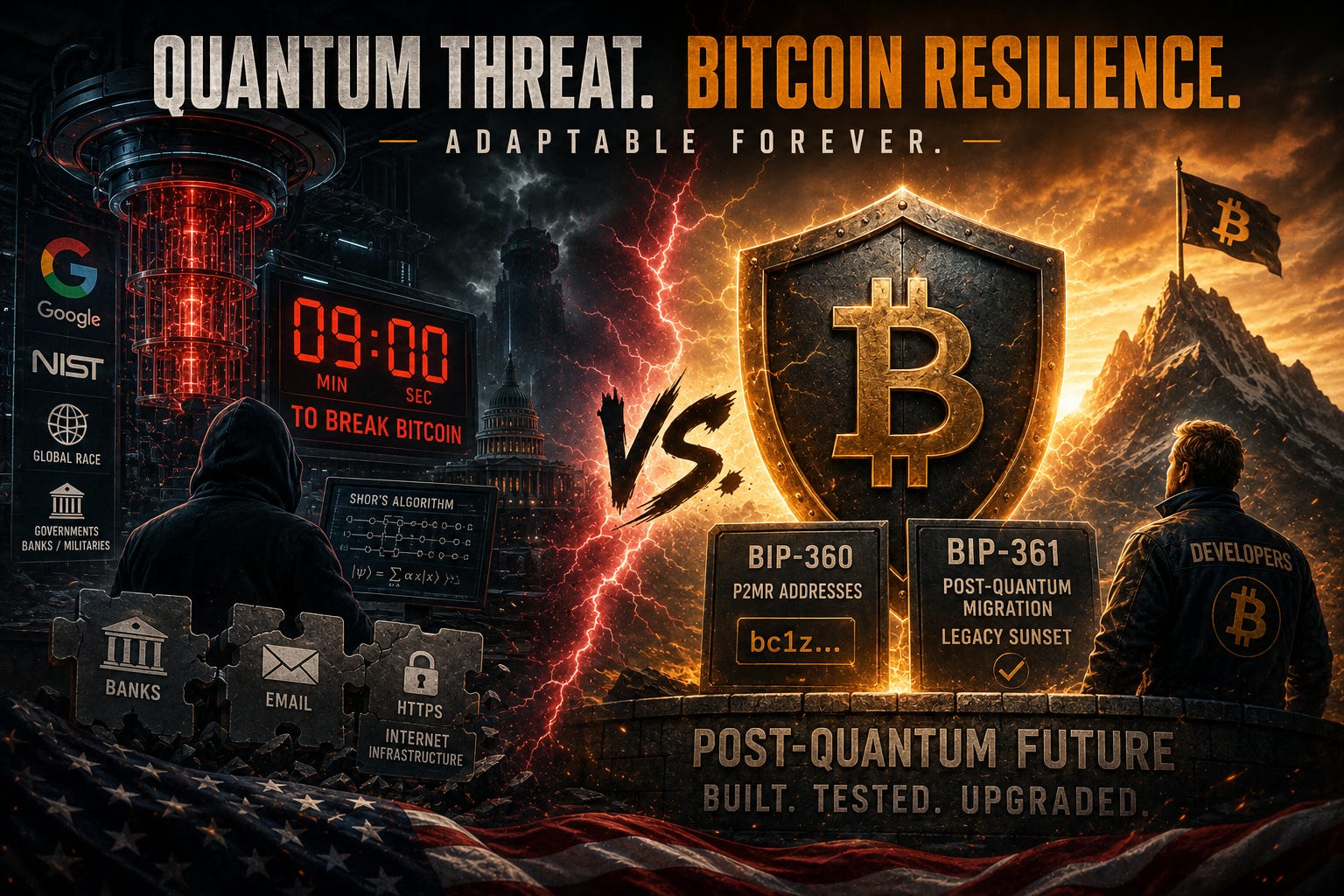
No — quantum computers cannot crack Bitcoin in 9 minutes, and none capable of threatening Bitcoin exist yet. Google’s research paper only estimated what it would take: a machine with 500,000 stable qubits, nearly 5,000 times more than Google’s current 105-qubit chip. That’s the real story lost in the panic headlines — and Bitcoin’s developers are already building the fix.
Here’s what Google actually said. Their researchers published a paper estimating that a quantum computer with around 500,000 stable physical qubits could theoretically break the cryptography protecting Bitcoin wallets. Not that it had happened. Not that such a machine exists. That IF you built one, here is roughly what it would cost in computing terms.
For context: Google’s current most powerful quantum chip — the Willow chip — has 105 qubits. The gap between 105 and 500,000 is not a software update. It is years, possibly decades, of engineering that nobody has solved yet.
The paper’s actual value is precise: it tightened the resource estimates so defenders can plan more accurately. It said “here is what you need to build to break this.” It did not say anyone has built it, or when they will.
Why Quantum Computers Are Different
To understand the threat, you need to understand one thing about how Bitcoin security works.
Every Bitcoin wallet has two keys. A private key — your secret, never shared, the thing that lets you spend your Bitcoin. And a public key — mathematically derived from the private key, visible to the network when you make a transaction.
The security of Bitcoin rests on one mathematical fact: you can go from private key to public key easily, but you cannot go backwards. Not in any reasonable timeframe. A classical computer trying to reverse-engineer a private key from a public key would take longer than the age of the universe.
Quantum computers change that equation. They run a process called Shor’s algorithm, which can solve the specific type of maths underlying Bitcoin’s cryptography exponentially faster than any classical machine. In theory, a sufficiently powerful quantum computer could derive your private key from your public key in minutes.
In theory. On a machine that does not exist yet. With qubits that are stable enough to sustain the calculation — a problem nobody has solved at scale.
But Here’s What the Headlines Miss
This is not a Bitcoin problem. It is an Internet problem.
The same cryptographic systems that protect Bitcoin wallets protect your online banking. Your email. HTTPS — the padlock in your browser. SWIFT transfers. Stock exchanges. Military communications. Every encrypted message sent by every government on earth.
If a quantum computer capable of breaking Bitcoin’s cryptography were built tomorrow, the first targets would not be crypto wallets. They would be bank servers, government databases, and financial infrastructure. The stakes for those institutions dwarf the entire crypto market.
Which means every government, every bank, every military, and every major technology company on the planet has a massive incentive to solve this problem before it becomes real. And they are all working on it. Google committed in March 2026 to transitioning its entire infrastructure to post-quantum cryptography by 2029. NIST — the US standards body — has already finalised post-quantum cryptographic standards. The world is not sitting still.
The Number That Should Get Your Attention
In April 2026, an independent researcher named Giancarlo Lelli did something that made the crypto security community sit up. He broke a 15-bit elliptic curve cryptography key using publicly available quantum hardware, winning a 1 BTC bounty from quantum security firm Project Eleven.
Before you panic: Bitcoin uses 256-bit encryption. A 15-bit key versus a 256-bit key is not a small gap. The difficulty scales exponentially, not linearly. Breaking a 15-bit key is impressive in a research context. Breaking a 256-bit key would require a machine roughly a billion times more powerful than anything that currently exists.
But here is why it matters. This result represents a 512-fold improvement over the previous public demonstration from September 2025. The curve is moving in one direction. Bernstein, the Wall Street research firm, put it plainly: Bitcoin and the broader crypto ecosystem have a three to five year window to complete a transition to post-quantum security before the risk becomes acute.
Three to five years is not tomorrow. But it is not comfortable either.
What Bitcoin Developers Are Actually Doing About It
This is where the story gets genuinely interesting — and where most of the media coverage has fallen short.
Bitcoin’s developer community has been working on this problem for years. Satoshi Nakamoto himself acknowledged in early forum posts that if quantum computing became practical, Bitcoin could migrate to stronger signature schemes. The upgrade flexibility was always part of the design philosophy.
In February 2026, Bitcoin Improvement Proposal 360 — BIP-360 — was officially published. It introduces a new address type called Pay-to-Merkle-Root (P2MR), which removes the specific part of Bitcoin’s current architecture that is vulnerable to quantum attack. Any Bitcoin moved into a BIP-360 address will be quantum-resistant. BIP-360 is already in testnet implementation. New addresses starting with “bc1z” will be the quantum-hardened option when it activates.
Then in April 2026, Jameson Lopp — one of the most respected names in Bitcoin security — and five co-authors published BIP-361, titled “Post Quantum Migration and Legacy Signature Sunset.” This is the more controversial proposal, and it deserves plain English treatment.
The Satoshi Coin Problem
Here is the uncomfortable reality that BIP-361 is trying to address.
Approximately 6.7 million Bitcoin — roughly a third of all coins that will ever exist — currently sit in address formats that expose their public keys directly on the blockchain. This includes an estimated 1.1 to 1.7 million Bitcoin widely believed to belong to Satoshi Nakamoto, currently worth around $74 billion. These coins have never moved. Their public keys are visible. A sufficiently powerful quantum computer could theoretically derive the private keys and drain them.
BIP-361 proposes a structured solution: give holders years to migrate to quantum-safe addresses. Those who migrate lose nothing. Those who do not migrate by a defined deadline would have their coins frozen — permanently inaccessible, removed from circulating supply.
The debate this has ignited is fierce. The Bitcoin community is deeply principled about property rights. The idea that anyone — even the network itself — could effectively confiscate coins that have not been moved is deeply uncomfortable for many long-term holders.
The counter-argument: those coins are either lost forever anyway, or they represent a ticking time bomb. If a quantum attacker drains Satoshi’s wallet and dumps 1.1 million Bitcoin onto the market, the effect on price and confidence would be catastrophic. Freezing them removes the risk and, as Satoshi himself once noted, permanently lost coins function as a donation to the rest of the network by making everyone else’s coins slightly more scarce.
BIP-361 is still a draft. It has no activation parameters defined. It will face an extended, contested debate before anything happens. But the fact that serious Bitcoin developers are proposing it tells you something important: the quantum timeline is being treated as real.
A Word on Quantum Marketing
Before we get to what you should actually do, it is worth pausing on something that happened at the Bitcoin 2026 conference in Las Vegas. A company called Qastle was announced as the Official Quantum Wallet of The Bitcoin Conferences through 2032 — a six-year exclusive deal with BTC Inc. Their claim: the world’s first quantum-secured hot wallet.
The Qastle wallet uses quantum random number generation to create keys, and applies post-quantum cryptographic methods to protect the wallet itself. That is genuinely better than nothing. Stronger key generation is a real improvement.
But here is what it does not solve, and what the marketing does not make clear. The quantum threat to Bitcoin is not about how your wallet generates keys. It is about what happens to your public key once it is on the blockchain.
When you broadcast a Bitcoin transaction — regardless of which wallet you use — your public key is exposed to the entire network. That is how the protocol works. A quantum attacker is not targeting your wallet soIf you found this useful, share it with someone who saw the scary headlines and assumed the worst. And if you’re not yet subscribed, this is what you get every week — the story behind the headline, in plain English.ftware. They are looking at public keys sitting on the blockchain and using Shor’s algorithm to reverse-engineer the private key from the public one. No wallet-side protection changes that. The attack surface is on-chain, not in your app.
Think of it this way. Imagine you have a very secure safe at home. Quantum-grade locks, unbreakable. But the key to that safe is printed on a public noticeboard. Someone with the right tools can copy the key from the noticeboard and walk straight past your safe. The safe’s security is irrelevant to that attack vector.
The real fix is what BIP-360 is building: a new address type at the protocol level that keeps public keys off-chain entirely, so there is nothing for a quantum attacker to work with. That requires a Bitcoin network upgrade — a soft fork that every node and wallet on earth adopts together. No single wallet company can do that alone, no matter how good their key generation is.
When you see “quantum-resistant wallet” marketing, it is worth asking exactly which threat they are protecting against. Securing the wallet itself is useful. Claiming to solve the on-chain public key exposure problem without a protocol-level upgrade is a different thing entirely.
What Should You Actually Do?
Calm down. You do not need to do anything drastic right now. But you should understand a few practical points.
Your Bitcoin address is not the same as your public key. In most modern wallet setups, your public key only becomes visible when you spend Bitcoin from an address. If you have never spent from a particular address — you only received into it — your public key is not yet exposed. This is a meaningful layer of protection that most coverage misses entirely.
Do not reuse addresses. Every time you spend from an address, your public key becomes visible. Using a fresh address for each transaction is good security practice anyway. It limits your exposure significantly.
Move away from legacy address formats. If your wallet uses addresses starting with “1” (the oldest format), consider moving to modern addresses starting with “bc1”. The 2026 consensus among security researchers: migrate to native SegWit or Taproot addresses. Ledger and Trezor have already released updated firmware making this straightforward.
Watch for BIP-360 activation. When quantum-safe addresses become available on mainnet — likely within the next one to three years if development continues at current pace — moving your long-term holdings there will be the right call. You will have plenty of time and warning before that matters.
Bitcoin has survived every existential headline thrown at it for fifteen years. The quantum threat is the most technically serious long-term challenge it has faced. But it is also the most anticipated, the most studied, and the one the entire global technology industry has a shared interest in solving. The window is three to five years. The tools are being built.
The Bigger Picture
There is something worth stepping back to appreciate here.
Bitcoin was designed to be upgraded. Satoshi built the upgrade mechanism in from the start, specifically acknowledging that cryptographic standards would need to evolve. The Bitcoin Improvement Proposal process exists precisely for moments like this. The fact that serious proposals are being debated openly, that testnet implementations are already running, that the timeline is measured in years rather than months — all of that is the system working as intended.
The alternative — a protocol that could not adapt to emerging threats — would be far more worrying. What we have instead is a global community of security researchers, developers, and cryptographers working openly on a known problem with a clear timeline.
That is not a crisis. That is engineering.
Q: Can quantum computers steal Bitcoin right now?
A: No. Breaking Bitcoin’s encryption would need a quantum computer roughly a billion times more powerful than the biggest one that currently exists.
Q: How long until quantum computers are a real threat to Bitcoin?
A: Security researchers estimate a three-to-five-year window before the risk becomes serious, based on the pace of recent quantum hardware demonstrations.
Q: What is Bitcoin doing to protect against quantum computers?
A: Developers have proposed BIP-360, a new quantum-resistant address format (addresses starting “bc1z”), already in testnet — plus BIP-361, a more contested proposal to migrate old, exposed coins like Satoshi’s.
If you found this useful, share it with someone who saw the scary headlines and assumed the worst. And if you’re not yet subscribed, this is what you get every week — the story behind the headline, in plain English.