


Why Are Institutions Buying While Everyone Else Has Stopped Watching?
Picture two very different rooms right now.
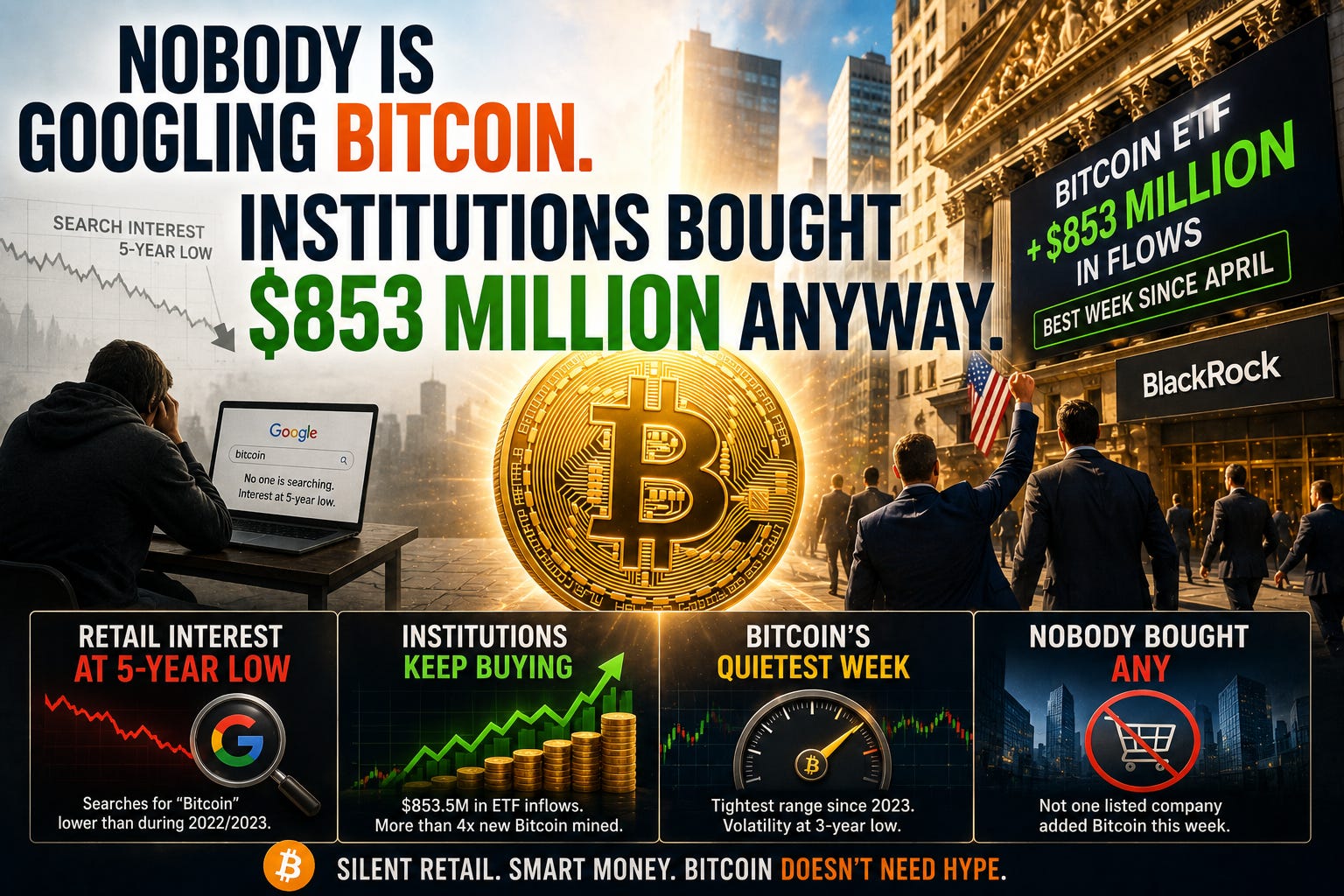
In the first room are ordinary people, the kind who search “Bitcoin” on Google when they are curious, worried, or thinking about buying. That room is almost empty. Search interest has fallen lower than it was during the brutal 2022 and 2023 crash, back when Bitcoin was worth a quarter of what it is today. People have simply stopped looking.
In the second room are the big institutional buyers, the funds and asset managers who buy Bitcoin through an ETF rather than an app on their phone. That room has been unusually busy. These funds bought $853.5 million worth of Bitcoin in the week to August 7, the best week since April, and BlackRock’s fund alone accounted for the vast majority of it. To put that in perspective, the whole Bitcoin network only produces around 3,150 new coins in a week. Institutional buyers alone soaked up more than four times that.
Put those two rooms side by side and you get a genuinely useful signal. Ordinary investors tend to pile in once everyone else is already excited and the price is moving. Right now, nobody is excited. The Fear and Greed Index, a simple daily read on the market’s mood, spent the entire week in Fear territory and never climbed above 27. Institutions do not really care about that mood. They tend to buy with a much longer view in mind. So when the crowd goes quiet and the professionals keep turning up anyway, that is usually a sign of real conviction, not hype.
Worth being honest about the scale of it too, though. As strong as that week was, it did not even last: by August 10, $144.6 million had already flowed back out. Zoom out further and Bitcoin ETFs have still paid out more overall this year than they have taken in. This was a good week. It was not a turning point.
Bitcoin Has Gone Eerily Quiet
The other side of that silence showed up in the price chart. Bitcoin spent the week pinned between roughly $63,400 and $65,400, its calmest stretch of trading since 2023. On Saturday it moved just $350 from its daily high to its daily low, the tightest single day in nearly three years. A measure of expected volatility called the Deribit DVOL index fell to around 35, down from roughly 90 earlier this year.
There is a mechanical explanation. On-chain data shows about 1.79 million Bitcoin sitting at an average purchase price between $62,000 and $65,000, which is exactly where the price is currently parked. That is a dense wall of holders all sitting on roughly break-even, and it naturally smothers movement in either direction.
Quiet is not the same as safe, though. Bitwise’s Luke Deans made the point well this week: thin participation and low liquidity can make a market more fragile, not less, because it takes less buying or selling to shove the price a long way. A market coiled this tightly, arriving just as the July inflation report and a run of major regulatory dates line up, does not tend to stay quiet for long.
The Coldcard Story Just Got Worse
We covered the Coldcard hardware wallet hack in detail over the past fortnight: a firmware bug from 2021 quietly weakened the randomness protecting thousands of wallets, and attackers drained more than $130 million once they worked out how to exploit it. This week brought the aftermath.
The scare triggered an industry-wide security sweep across Bitcoin-related software, which turned up 85 additional critical bugs across 390 different code repositories. None are confirmed to have been exploited, but it is a sobering look at how much unglamorous security work goes unnoticed until something breaks. Galaxy Research also now believes the Coldcard theft involved at least 12 to 15 separate attackers rather than one group, spread across roughly 7,300 addresses. Around 90% of the stolen coins still have not moved.
Coinkite, the company behind Coldcard, made one telling move this week. It suspended its usual policy of automatically deleting old customer data after 120 days, citing “legal obligations arising from the security incident.” That is what lawyers call a litigation hold, and a class action is reportedly forming.
It still has not published an official final total for the losses, and there is a good reason for that beyond simply being slow. Coinkite does not keep records tying customers to the specific devices they buy, that is a deliberate privacy choice, and it has no way of knowing which private keys any given device ever generated, let alone which Bitcoin addresses those keys control. The only way Coinkite could ever learn about a theft is if an affected customer contacts them directly, and even then there is no way to prove the claim is genuine rather than mistaken or exaggerated. The $130 million figure comes from independent blockchain researchers piecing together suspicious fund movements, not from Coinkite itself, and the true total may never be fully known by anyone.
Strategy Sold Again. Nobody Bought at All.
Michael Saylor’s Strategy sold 1,690 Bitcoin this week for roughly $108.6 million. That works out to an average price of $64,262 a coin, well below the company’s own average cost of $75,385. It is the second week in a row Strategy has sold rather than bought. The company also raised $653 million by selling shares, which pushed its cash reserve up to $4.65 billion. Strategy now holds 840,447 Bitcoin in total, and is sitting on an unrealised paper loss of around $8.7 billion.
A smaller company had a considerably rougher week. Empery Digital’s quarterly filing revealed it sold 1,635 Bitcoin for $102.2 million between July and early August. That cut its holdings from 1,375 coins down to just 325, a 76% reduction in a matter of weeks. Unlike Strategy’s managed drawdown, Empery’s own numbers point to genuine strain: just $3.7 million of cash against a $5.7 million shortfall. Strategy is choosing to sell. Empery looks like it had to.
The detail that ties it together is what did not happen. Not one publicly listed company disclosed buying any Bitcoin this week. The corporate treasury buying spree that powered much of the last two years has, at least for now, gone into reverse. Saylor has defended the sales as proof a position this size can be trimmed without disrupting the market. Analysts increasingly read it as the buying phase being over.
Washington Punts, Regulators Move Anyway
The Clarity Act, the biggest pending piece of US crypto legislation, did not get its vote before the Senate broke for summer. Majority Leader John Thune filed the procedural paperwork at 4:52am on Saturday morning after an overnight session, which keeps the bill alive and sets up a vote for September 15, the day after the Senate returns. It needs 60 votes. Republicans hold 53, so at least seven Democrats have to cross over, and reporting suggests the realistic number is closer to ten.
The sticking points are the same ones we have covered for weeks: ethics rules restricting senior officials from backing crypto projects, stablecoin yield, and illicit finance provisions. A revised ethics compromise has reportedly been sitting at the White House awaiting sign-off for over a week. The dispute is not abstract either. The New York Times reported this week that World Liberty Financial received $100 million from a UK businessman under money laundering investigation, which is close to precisely the scenario the disputed provisions are meant to address.
Regulators are not waiting around, though. The SEC has scheduled a vote for Friday, August 14, on something informally called “Regulation Crypto.” If approved, it would be the agency’s first ever formal crypto rulemaking rather than guidance a future SEC could reverse overnight. It would create a tailored path for crypto projects to raise funding legally, something that currently does not properly exist in the US. A vote opens it for public comment rather than making it law immediately, but it is a durable step that Congress keeps failing to take. The CFTC has separately said its own rules are ready to go, with or without a new law.
Quick Hits
A Bitcoin fork died after two blocks. BIP-110, a proposal to restrict certain non-financial data from Bitcoin transactions, split off from the main network but attracted only 2.5% of mining support against the 55% it needed. It mined exactly two blocks and stopped. The bigger story came next: a fellow developer moved to remove the proposal’s author, Luke Dashjr, from his long-held role reviewing new Bitcoin proposals, and it was approved within 26 hours. Whatever you think of the proposal, a governance change that fast is genuinely rare in Bitcoin.
Bybit sued North Korea, and won a freeze. Bybit filed a US federal lawsuit against North Korea, its intelligence agency, and the Lazarus Group over last year’s $1.5 billion hack, still the largest crypto theft on record. A court granted an asset freeze covering roughly $30.5 million of stolen funds held across various platforms. Suing a country that will never turn up in court sounds pointless, but it lets Bybit legally freeze funds wherever they surface without needing anyone’s cooperation.
Treasury widens its Iran crypto net. The US sanctioned eight more parties across four countries linked to Iranian crypto exchanges laundering money for the regime, tracing over a million dollars moving through wallets connected to Iran’s Revolutionary Guard. Dubai’s regulator had already shut down one of the same firms days earlier, a rare case of two jurisdictions landing on the same target in the same week.
Mastercard finishes its $1.8 billion stablecoin deal. Mastercard closed its purchase of stablecoin infrastructure company BVNK five months early. BVNK handles around $30 billion a year in stablecoin payments across 130 markets, making Mastercard the first major card network to actually own this kind of infrastructure rather than just partnering with someone who does.
Bitcoin miners are splitting into two camps. Riot Platforms signed a 20-year deal worth up to $9.1 billion leasing part of its facility to an AI company, a far more lucrative use of its power than mining Bitcoin right now. Marathon Digital, meanwhile, reported a $611 million quarterly loss. At current prices, mining profitably has become genuinely hard for anyone without cheap power or a second revenue stream.
The Bigger Picture: The Fed Is Stuck Again
July’s jobs report landed as a genuine shock. The US economy lost 23,000 jobs when economists had expected roughly 80,000 gained. On top of that, the previous two months were revised down by a further 103,000 jobs combined. Normally that pushes the Federal Reserve toward cutting interest rates. Except under new Chair Kevin Warsh, several Fed officials are actively debating whether to raise them instead, because oil has climbed toward $90 a barrel as the Strait of Hormuz standoff drags on. Three officials formally dissented in favour of a hike at the last meeting, and half the committee expects at least one this year.
Gold is up roughly 28% over the past twelve months. Bitcoin, over the same period, is down about 46%. That is not the outcome most people would have predicted for a year featuring a war, an inflation scare, and a supportive US administration.
The July inflation report is the next real catalyst, and it is the single biggest input into the Fed’s September decision. Between that, Friday’s SEC vote and the Clarity Act’s September date, the weeks ahead are shaping up considerably louder than the one just gone.
The SEC votes on Regulation Crypto this Friday, and the Clarity Act returns on September 15. I’ll cover both the moment there is real news. Make sure you’re subscribed.
And Finally…
The FBI Agent Who Asked ChatGPT How to Spend His Stolen Crypto
A former FBI supervisory intelligence agent has been charged with using his own Top Secret security clearance to memorise seed phrases and steal nearly $1 million in crypto from wallets the FBI itself was investigating. The detail that elevates this from ordinary insider crime to genuinely remarkable: he reportedly asked ChatGPT for advice on how to spend the money and relocate to Portugal, with power of attorney paperwork and family travel arrangements already in motion. Even the professionals apparently need a second opinion before fleeing the country.
People Actually Unplugged Their Price Clocks
Amid the Coldcard panic, a programmer posted an urgent warning telling Bitcoin holders to physically unplug their BlockClock, a desk gadget whose entire function is displaying the Bitcoin price, after a parody account joked it secretly contained a “Russian military-grade listening device.” The warning reached 50,000 views before the original poster admitted it was, in his own words, “schizo panic fear.” Real people unplugged their price clocks anyway.
Quick Questions
Q: If retail interest is at a five-year low, is that a bad sign?
A: Not necessarily. Low retail attention alongside strong institutional buying has historically lined up more with quiet accumulation phases than with market tops. It is not a guarantee of anything, but it is not a warning light either.
Q: Does low volatility mean Bitcoin is about to crash?
A: No, it just means the price has been unusually stable. A tightly coiled market can break upward as easily as downward. What it does suggest is that when it moves, it may move sharply.
Q: Is the Clarity Act dead now it has been delayed again?
A: No. The procedural motion filed this week specifically keeps it alive, with a vote set for September 15. It still faces a real hurdle in needing around ten Democratic votes to pass.