


The Problem With Bitcoin, According to Wall Street
Ask a traditional investor why they haven’t bought Bitcoin and you’ll usually get one of two answers.
The first is volatility. Bitcoin moves 10%, 20%, 30% in a matter of weeks. For someone whose job is to protect capital and generate predictable returns — a pension fund manager, a retiree, an income-focused investor — that kind of movement is terrifying. The upside is attractive. The ride is not.
The second is yield. Bonds pay interest. Dividend stocks pay quarterly income. Property pays rent. Bitcoin pays nothing. It just sits there. For a huge portion of the investing world, an asset that doesn’t generate income isn’t really an asset at all. It’s a speculation.
BlackRock just solved both of those problems in a single product. And it launched this week.
Meet BITA: Bitcoin That Pays You
The iShares Bitcoin Premium Income ETF — ticker BITA — started trading on Nasdaq on June 16. It is the first Bitcoin income product from a major asset manager, and it works in a way that is worth understanding properly.
Here is the plain English version.
BITA holds two things: direct spot Bitcoin, and shares of BlackRock’s own spot Bitcoin ETF, IBIT, which already has over $100 billion in assets. The direct Bitcoin holding is there for tax efficiency — it allows capital losses to pass through to investors. The IBIT shares are the portion used for the options strategy. Either way, you buy BITA, you own Bitcoin exposure. The fund charges a 0.65% annual fee — higher than IBIT’s 0.25%, but lower than competing income Bitcoin products.
But then it does something clever with that Bitcoin. Every month, BITA sells what are called call options against a portion of its holdings — roughly a quarter to a third. A call option is essentially a contract that gives someone else the right to buy Bitcoin from you at a set price. In exchange for selling that contract, BITA receives a payment upfront. That payment is the income.
Think of it like renting out a room in your house. You still own the house. You still benefit if the house goes up in value. But every month, someone pays you rent, and that rent becomes your income. The trade-off: if house prices rocket above a certain level, the tenant has the right to buy at the agreed price and you miss some of the upside. You gave up a slice of the big gain in exchange for steady monthly payments.
BITA targets a 15 to 25% annual yield from this strategy. To put that in context: the average UK savings account currently pays around 4–5%. A ten-year US Treasury bond pays around 4.5%. BlackRock is offering Bitcoin income that could be three to five times that. The catch is that if Bitcoin goes on a massive run, BITA holders will capture less of it than someone holding Bitcoin directly. But for an investor who needs income rather than speculation, that trade-off is entirely rational.
Robert Mitchnick, BlackRock’s head of digital assets, said the quiet part out loud. “A significant share of our clients are interested in Bitcoin, but they are also highly focused on generating income.” BITA was built for exactly those clients. And BlackRock’s Chief Investment Officer Rick Rieder said on Bloomberg that he thinks “Bitcoin is ultimately going considerably higher.” The world’s largest asset manager is not hedging its view.
One more detail worth knowing: Goldman Sachs was building a near-identical product. BlackRock filed its paperwork on June 11, got SEC approval on June 15, and listed on June 16 — beating Goldman to market. In the race to own the Bitcoin income category, BlackRock moved first and fast.
Who Is This Actually For?
BITA is not for everyone. If you are a long-term Bitcoin holder who believes Bitcoin is going to $200,000, $300,000, or beyond, you probably do not want to cap your upside in exchange for monthly income. Just hold Bitcoin directly and go about your day.
But BITA opens a door for a completely different type of investor who has never been able to own Bitcoin before.
Pension funds have mandates that require income-generating assets. Endowments and foundations need to generate regular distributions to fund their operations. Retirees living off their portfolios need monthly cash flow. Wealth managers running income-focused client portfolios need yield. For all of these investors, Bitcoin with a 15–25% income yield is a fundamentally different conversation than Bitcoin with no yield.
As we recently covered, the UK FCA proposed allowing mainstream investment funds to hold up to 10% of their assets in crypto products. UK authorised funds manage trillions of pounds. BITA-style products are exactly the kind of structured, income-generating Bitcoin exposure that fund managers in those vehicles would actually be allowed to use. The timing is not a coincidence. The infrastructure is being built for a wave of institutional demand that is still arriving.
How Does BITA Compare to STRC and SATA?
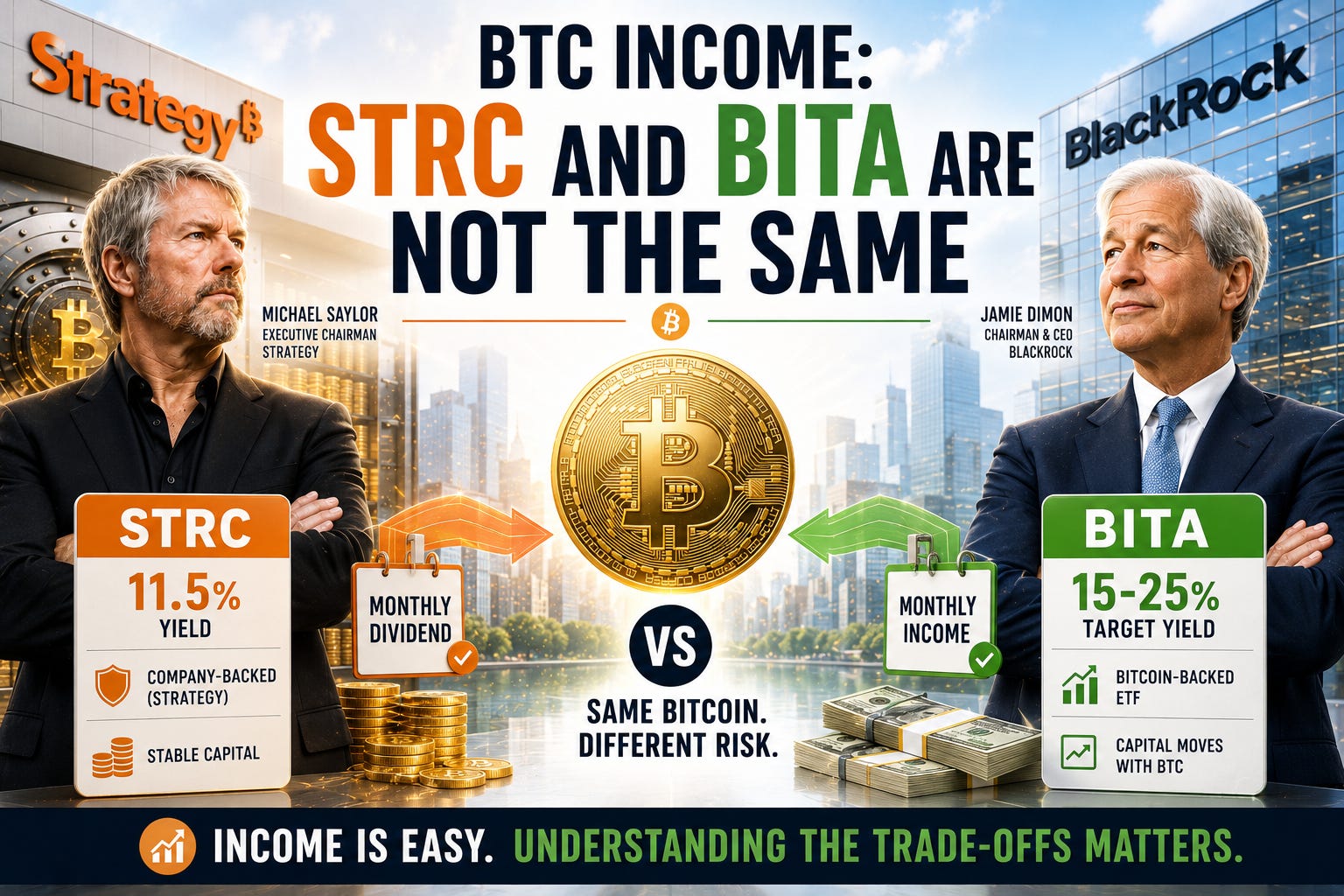
If BITA sounds familiar, it should. Two products have been doing something similar for over a year: Strategy’s STRC — the brainchild of Michael Saylor, who has bought more Bitcoin than any other corporate operator on earth — and Strive’s SATA. The principle across all three is the same: use Bitcoin as the engine, build yield on top of it, and attract income investors who wouldn’t otherwise touch crypto. But they work differently, and the risks are different too.
STRC — Strategy’s Stretch product — pays an 11.5% variable annual dividend. It has raised over $8.5 billion and is now the largest preferred stock by market cap in the world. Every dollar raised goes straight into buying Bitcoin.
SATA — Strive’s almost identical product — works the same way but pays 13%, a higher rate that compensates for Strive being a smaller, less liquid company. It now holds over 19,000 Bitcoin and as of June 16 became the first listed security in US capital markets history to pay daily cash dividends rather than monthly. Both STRC and SATA are preferred shares in companies. When you buy them, you are essentially lending money to Strategy or Strive respectively, trusting them to keep buying Bitcoin and paying your dividend. If either company ran into serious trouble, you would be a preferred creditor — ahead of common shareholders, but still exposed to that company’s balance sheet.
BITA works differently. It holds both direct spot Bitcoin and shares of IBIT — not as a company treasury, but inside a regulated ETF structure. The yield comes from selling options on the IBIT portion, not from anyone’s creditworthiness. There is no corporate balance sheet between you and the asset. If BlackRock’s ETF business somehow failed, the underlying Bitcoin would still be there, although since Strategy’s and Strive’s entire business model is Bitcoin accumulation, this is more of a structural difference than a practical one.
The trade-off cuts both ways, and it’s worth being honest about it. STRC pays 11.5% and SATA pays 13% regardless of what Bitcoin does — if Bitcoin doubles, your yield stays the same. But here’s the equally important flip side: if Bitcoin halves, your STRC and SATA dividend still arrives. Both products are actively managed to trade at or near $100 per share at all times, regardless of the Bitcoin price. Your capital position is stable. You put in $100, you expect to get roughly $100 back, and you collect the income on top. It behaves more like a bond than a Bitcoin investment in that respect. You are exposed to company risk, not Bitcoin price risk.
BITA has no such mechanism. Your capital moves with Bitcoin — roughly 70% of every price swing, up or down. And this creates a subtlety that is easy to miss: the percentage yield and the actual cash you receive are two very different things.
Here is why 18% can be worth less than 11.5%.
Say you invest $10,000 in BITA when Bitcoin is riding high. BITA is yielding 18%. Great. But then Bitcoin drops 40%. Your $10,000 holding is now worth around $7,200 — because BITA follows 70% of that move downward. The yield is still 18%, but 18% of $7,200 is $1,296 a year. Meanwhile, someone who put $10,000 into STRC is still sitting on a $10,000 capital position paying 11.5% — that’s $1,150 a year, from a pot that hasn’t shrunk. In that scenario, the 11.5% product is paying more in real money than the 18% one. Capital base matters as much as yield percentage.
Of course, the reverse is also true. If Bitcoin doubles from your entry point, your BITA holding grows to around $17,000, and 18% of that is a very attractive income. STRC holders are still collecting 11.5% on their stable $10,000. In a strong Bitcoin market, BITA wins on both the capital and the income. In a falling market, it loses on both.
In simple terms: STRC and SATA are stable capital, predictable income, company risk. BITA is Bitcoin exposure with an income layer on top — the income and the capital move together with the Bitcoin price. Neither is better. They are different tools for different investors with different needs. All three are targeting income investors who could not justify owning Bitcoin before. Together they represent the beginnings of an entirely new asset class — Bitcoin-native income products engineered for the traditional finance world. (Not financial advice.)
While That Was Happening, the SEC Quietly Did Something Huge
BITA was the headline. But something equally significant happened the same week that received almost no mainstream coverage — and it matters far beyond Bitcoin.
Right now, if you want to buy a share of Apple, your trade settles in two business days. The stock exchange is open Monday to Friday, roughly 8am to 4.30pm. If something dramatic happens to Apple on a Saturday night, you cannot do anything about it until Monday morning. And the paperwork behind every trade runs through a chain of brokers, clearinghouses, and custodians that was built in the 1970s and has barely changed since.
Blockchain fixes all of that. Stocks on a blockchain settle in seconds, not days. Trading is 24 hours a day, seven days a week. The entire chain of intermediaries collapses into code. Costs fall dramatically. Errors are eliminated. Global investors can access any market at any time without going through a web of middlemen.
The technology has existed for years. The problem has been legal. One rule, written in 2005, has been making it almost impossible to do legally in America. Until this week.
On June 11, the SEC proposed scrapping Rule 611 of Regulation NMS — the trade-through rule that has governed US stock market trading for twenty years. Here is why it has been such a problem.
When you buy a share on the New York Stock Exchange, Rule 611 says your trade must execute at the best available price across all US exchanges simultaneously. The intention was good — protect investors from being ripped off. But blockchain trading uses automated systems called liquidity pools that cannot pause a trade to check what every other exchange in America is quoting at the same moment. Under Rule 611, every single trade on a blockchain-based stock market would technically be illegal.
As Galaxy Digital’s head of research Alex Thorn put it, the rule meant any blockchain trading platform would be “committing trade-throughs constantly and arguably be an illegal trading center.”
Christopher Perkins of 250 Digital Asset Management summed up what the change means: “It’s a whole new ballgame.”
The SEC proposal replaces Rule 611 with a simpler “best execution” standard — brokers must try to get the best price for clients, without the rigid mechanical requirement that makes blockchain trading impossible. A final vote is expected by early 2027.
Citi has already launched a platform for tokenised shares of private companies. Nasdaq and the DTCC — the plumbing of the US stock market — are actively building tokenised settlement infrastructure. Citi projects the tokenised asset market could reach $5.5 trillion by 2030. The legal blocker just moved out of the way.
The Bigger Picture: Two Steps Toward the Same Place
BITA and the Rule 611 proposal look like separate stories, but they aren’t.
Both are steps in the same direction: the merger of traditional finance and Bitcoin.
BITA brings Bitcoin into the income-investing world — making it accessible to pension funds, endowments, and retirees who couldn’t justify owning it, or couldn’t legally access it. Rule 611’s removal opens the door for stocks, bonds, and other traditional assets to move onto blockchain infrastructure — making them faster, cheaper, and more accessible globally.
The direction of travel is toward a financial system where Bitcoin and traditional assets occupy the same rails. Where your pension fund owns Bitcoin exposure as part of a yield strategy. Where the Apple shares in your ISA settle on a blockchain in seconds rather than two business days. Where the distinction between “crypto” and “finance” stops making sense because they have become the same thing.
That world is not here yet. BITA is one product. Rule 611 is a proposal, not a law. The Clarity Act is still working its way through the Senate. There is plenty of road still to travel.
But the direction has never been clearer. And the speed has never been faster.
Jamie Dimon called Bitcoin a fraud in 2017. BlackRock — the firm that manages more money than any other on earth — launched a Bitcoin income product this week paying three to five times what his bank’s savings accounts offer. The SEC is dismantling twenty-year-old rules to let stocks trade on blockchain around the clock.
Something fundamental is changing. And this week, you got to watch two more pieces of it fall into place.
The Clarity Act is pushing for a Senate floor vote before the August recess. The FCA consultation on Bitcoin in UK pension funds closes July 13. I’ll cover both as they develop. Make sure you’re subscribed.