


Why Did the Buyers Suddenly Disappear?
Last week we told you retail investors had stopped watching Bitcoin altogether, while institutions kept quietly buying anyway. That gap was the whole story. This week, the second half of that story broke down too.
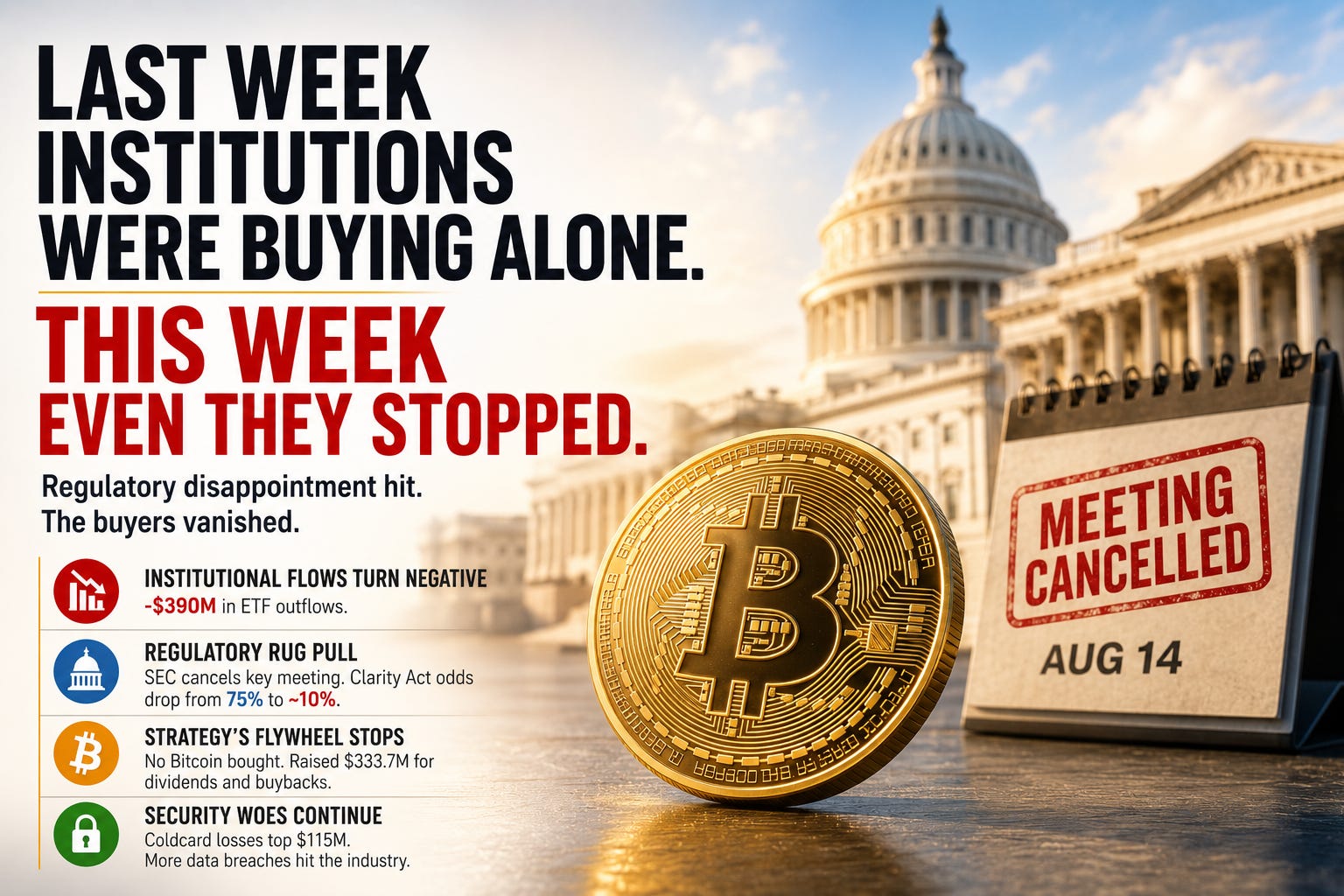
US Bitcoin ETFs handed back $390 million over the week, their worst run in six weeks. That alone would be a fairly ordinary bad week. What made it different is who joined in. BlackRock’s IBIT, the single largest Bitcoin fund in the world, has spent most of its life doing the opposite of what smaller funds do. When everyone else sells, IBIT usually keeps absorbing money. This week IBIT sold too, including one single day where investors pulled $55 million straight back out.
That matters more than the headline number suggests. It effectively erased the $853 million that flowed in just the week before, the best week since April that we wrote about only seven days ago. A swing that size in a single week is the clearest sign yet that even the most patient money in the room briefly lost its nerve.
The Regulatory Rug Pull
Here is what actually spooked them. On August 13, the SEC cancelled a meeting it had scheduled for the very next day, a meeting where it was expected to formally propose “Regulation Crypto,” the first serious rulebook the agency had ever put forward for the industry. No reason beyond a vague “scheduling issue” was given. No new date was set.
The timing could not have been worse. Galaxy Digital’s head of research, Alex Thorn, had been putting the odds of the Clarity Act, the much bigger bill meant to settle crypto regulation in Congress, at around 75% back in May. This week he cut that estimate all the way down to roughly 10%. A Senate vote is technically still scheduled for September 15, but the confidence behind it has collapsed.
Reporting suggests the White House itself asked the SEC to hold off, worried that a new rule right now could disrupt the delicate negotiations still happening around the Clarity Act. In trying to protect one path to regulatory clarity, Washington ended up stalling both of them at once. For an industry that has spent two years asking for nothing more than clear rules, watching the rulemaking get shelved to protect the rulemaking is its own kind of answer.
Strategy’s Flywheel Has Stopped
Michael Saylor’s Strategy did something it has not done in a very long time this week: nothing. No Bitcoin bought. No Bitcoin sold. Just a company sitting still, holding 840,447 Bitcoin at an average cost of $75,385, with an unrealised loss approaching $10 billion.
The company still needed cash, though. It raised $333.7 million by selling new shares, and used the proceeds mostly to pay preferred dividends and buy back some of its STRC stock. Not one dollar of it went toward buying more Bitcoin. The engine that made Strategy famous, raising money specifically to buy Bitcoin, appears to have genuinely paused.
There is a second, more structural threat brewing alongside it. Index provider MSCI opened a consultation this week proposing to remove Strategy, along with two similar companies, from its stock market indices entirely, under a new rule targeting companies that mostly just hold digital assets rather than run an operating business. JPMorgan estimates that removal could force roughly $2.8 billion out of Strategy’s shares, simply because funds that track those indices would be required to sell. The consultation closes at the end of September, with a decision due in mid-October.
The Coldcard Saga, and Company, Gets Worse
We have tracked the Coldcard hardware wallet hack for three weeks now. Confirmed losses passed $115 million this week, with researchers warning the real total could exceed $130 million once everything is accounted for. Coinkite has fixed the underlying bug and stopped shipping affected devices, but it is offering no compensation fund. Its own terms of sale cap what it owes any individual customer at whatever they originally paid for the device.
It was not a good week for hardware wallet security more broadly, either. Trezor confirmed a breach of 14,000 customers’ shipping data. SafePal confirmed nearly 40,000. An Israeli exchange called Bits of Gold reported around 200,000 customers exposed, including national ID numbers and bank details. None of these are Coldcard-related. They simply landed in the same seven days, turning a bad month for cryptography into a genuinely rough one for customer privacy across the whole industry.
Quick Hits
The US Treasury moved on stablecoins. Treasury proposed the actual licensing rules for the GENIUS Act, the stablecoin law we covered back when Trump signed it. The rule spells out exactly who needs a licence to issue a stablecoin in America and requires foreign issuers to prove they can comply with US legal orders when required. It is a genuinely rare thing this week: a piece of US crypto policy that actually moved forward rather than stalling.
Russia both welcomed and squeezed Bitcoin in the same week. Russia’s central bank named Bitcoin, Ether and the dollar-pegged stablecoin USDT as the only crypto assets ordinary Russian investors will be allowed to buy from September, a real, if grudging, stamp of legitimacy from a government that has spent years threatening an outright ban. Days later, the same government banned Bitcoin mining in Moscow and the surrounding region entirely until 2032, an area responsible for a meaningful slice of the world’s total mining power. Opening the door to Bitcoin as an investment while shutting it as an industry is a strange combination, but it is the one Moscow chose.
Bitcoin’s mining security budget is under real strain. Network hashrate, the total computing power protecting Bitcoin, has fallen by about a third since its October peak. Transaction fees now make up less than 1% of miner income, the lowest share in a decade. Miners are increasingly leasing their facilities to AI companies instead, which pays better right now than mining does. None of this puts Bitcoin at immediate risk, but a smaller, less profitable mining industry is a genuinely less secure one over time.
The SEC has not set a new date for Regulation Crypto, and the Clarity Act still technically faces its Senate vote on September 15. I’ll cover both the moment there is real movement. Make sure you’re subscribed.
And Finally…
CZ Got Chased Off His Own Wallet by Meme Coins
Changpeng Zhao, the founder of Binance, retired his own public Bitcoin wallet this week, donating nearly a million dollars from it to charity in the process. His stated reason was almost funny enough on its own: strangers had spammed his wallet with so many random, unsolicited meme coins that he could no longer find his own transactions in the interface. The other reason was less charming. Traders had turned watching his every move into a strategy, copying his trades in real time, with one reportedly turning it into a 29 times return. Crypto’s most recognisable person effectively got pushed off the transparent ledger he has spent years championing, by the very transparency that made him famous.
Two “Unchangeable” Blockchains Hit Undo in the Same Week
Ravencoin and Harmony, two much smaller blockchain projects, both announced plans this week to roll back their own transaction history after separate hacks, deleting real transactions that had already happened to undo the damage. Blockchains are supposed to be permanent by design, that is meant to be the entire point. Watching two of them hit the equivalent of Ctrl+Z in the same seven days is a useful reminder that “unchangeable” often turns out to mean “very hard to change,” not “impossible.”
Quick Questions
Q: Does IBIT selling for the first time mean BlackRock has lost confidence in Bitcoin?
A: Not necessarily. One week of outflows after months of steady buying is not the same as a change of view. It is a genuine shift worth watching, but a single week rarely tells you someone’s long-term thinking has changed.
Q: If Strategy gets removed from MSCI’s indices, does that affect the Bitcoin I hold?
A: No. It affects Strategy’s share price and which funds are allowed to hold Strategy stock. It has no direct effect on Bitcoin itself or on Bitcoin held outside of Strategy.
Q: Is my Bitcoin at risk from the falling hashrate?
A: Not right now. Bitcoin’s network is still enormously more secure than any realistic attacker could overcome. It is a trend worth watching over years, not something that threatens your holdings today.