


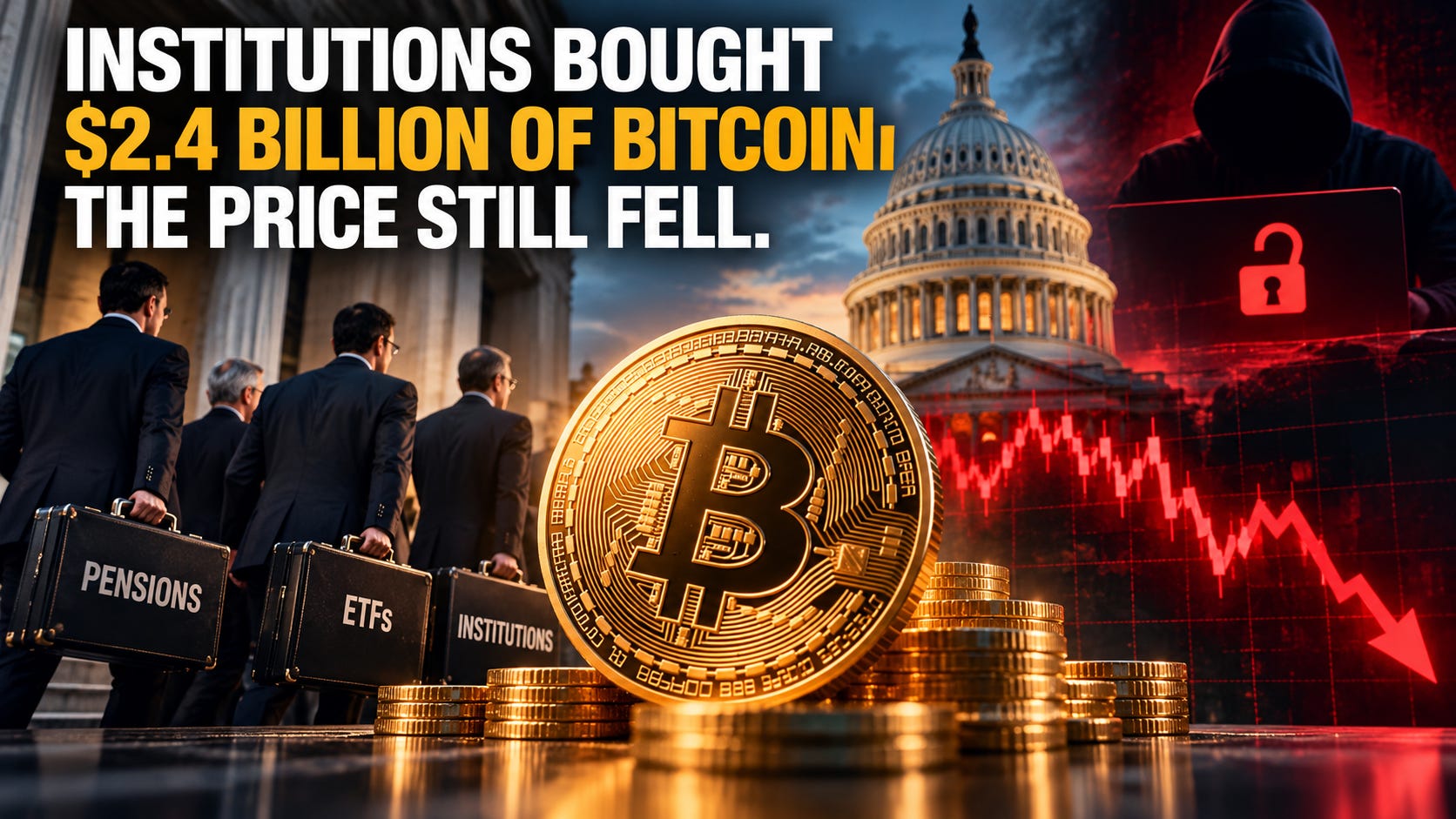
How Can Record Buying Come With a Falling Price?
Because the buyers were not the only people in the room. US Bitcoin ETFs took in $2.39 billion in the week to September 25, their biggest week since October last year. That was enough to turn their total flows for 2026 positive for the first time, after sitting almost $6 billion underwater in the middle of July. Bitcoin still finished the week about 2.3% lower, at around $84,000, after briefly touching an eight-month high above $87,000.
Every Bitcoin bought is a Bitcoin someone else sold. At $87,000, plenty of existing holders decided it was a good moment to take profit, and they had a strong reason to feel nervous. The yield on a ten-year US government bond climbed above 5.25%, the highest of this cycle, and oil pushed back above $100 a barrel after talks between the US and Iran stalled. A savings product paying over 5% with no risk is serious competition for anything that pays nothing, Bitcoin included.
Does This Break Last Week’s Argument?
Last week we made the case that rising interest rates are no longer simply bad news for Bitcoin, because they make America’s $40 trillion debt more expensive to refinance, and that bill is likely to be paid with newly created money. That longer-term argument has not changed. If anything, a 30-year government bond now yielding over 5.5% makes the government’s interest bill even harder to ignore.
What this week shows is that the short term and the long term can pull in opposite directions. Over years, debasement is the force that matters. Over a few days, a sudden jump in bond yields still makes some investors sell first and think later. Bitcoin also posted its highest weekly closing price in eight months, even while ending the week down, which is what a market looks like when it is catching its breath rather than turning around.
The more telling detail is who kept buying. ETF money flowed in for seven days in a row, straight through the price drop. That is long-term money, pension funds and financial advisers allocating through regulated products, and it does not appear to be reacting to daily price moves at all. The question for the next few weeks is simply which side gets tired first: patient institutional buying, or nervous profit-taking every time bond yields spike.
The $387 Million Hack That Started With a Sandwich
The largest crypto theft of 2026 so far happened on September 24 at Bitget, one of the world’s bigger exchanges. The attacker got in through a previously unknown flaw in a piece of third-party security software, which handed them genuine administrator login details. That is worth pausing on. The tool meant to protect the exchange became the way in.
What they did next was patient and clever. Before touching anything large, the attacker sent two tiny test transfers, worth roughly the price of a sandwich, deliberately kept below the size that would trigger Bitget’s alarms. Nothing happened. Thirty minutes later they moved the real money in 17 transactions across several blockchains in about 70 minutes. Bitget’s first estimate of the loss was $351.6 million, revised a day later to $387.5 million. Its chief executive has attributed the attack to North Korea, which, according to Bloomberg, has now stolen more than $1 billion in crypto this year alone.
There is some good news. Bitget’s own $465 million protection fund is covering the losses, its cold storage was never touched, and customers should be made whole. But the day withdrawals reopened, around $463 million walked straight out of the door anyway. That is the real cost of a breach now: not just the stolen money, but the trust that leaves with it.
It is the second week in a row we have written about a custodial platform being breached, after the Blink wallet last week. The lesson is the same one it always is. When an exchange holds your Bitcoin, its security problem is your security problem. When you hold your own keys, properly, a hack like this cannot touch you.
Meanwhile, the Plumbing Is Quietly Being Rebuilt
The most important stories of the week will not move the price tomorrow, but they matter more over the long run. The CFTC, the regulator for futures markets, published guidance allowing Bitcoin to be used as margin, which is essentially a deposit or collateral, inside America’s regulated derivatives markets. Until now, Bitcoin could be something you traded. Now it can also be something you post as security, the same way a bank treats a house or a government bond. That is a quiet but real step towards Bitcoin being treated as a serious financial asset rather than a speculative one.
The same week, NYSE Group, which owns the New York Stock Exchange, signed an agreement with Blockchain.com to explore trading tokenised versions of US stocks and funds around the clock. The Clearing House, a payments network owned by America’s largest banks, picked a software company called Quant to help it move tokenised bank deposits between institutions from next year. None of these deals involve buying Bitcoin directly. They do show traditional finance steadily moving onto blockchain rails, and every step in that direction makes the whole idea a little less strange to the people who control most of the world’s money.
On the regulatory side, the SEC’s staff published new guidance on the Howey test, the decades-old legal test the SEC uses to decide whether something counts as an investment contract, and therefore a security. The new guidance covers common crypto structures like token buybacks and staking. It is not binding law and a future SEC could withdraw it, but with the Clarity Act now dead for this year, guidance like this is what crypto companies will actually build around.
Quick Hits
Strategy and Strive kept buying. Strategy bought 1,665 Bitcoin at an average of $85,706, taking it to 847,666 in total. Strive added 1,107, lifting its holdings to 27,462. Both paid above where Bitcoin finished the week, so both purchases started out slightly underwater. Corporate buying is back after the summer pause, but it is concentrated in a small number of companies that buy regardless of price.
Bitcoin’s share of the crypto market slipped. Bitcoin dominance, its share of the total value of all crypto, fell below 60% for the first time this cycle, to 58.5%. Some money is drifting into smaller coins, though not enough yet to call it an “altcoin season.”
Binance faces its second Iran investigation. As we noted last week, federal prosecutors are reportedly examining whether Binance processed trades for Iranian users. Sanctions law, not securities law, is now the biggest legal risk for global exchanges.
Bond yields and oil are the two numbers to watch in the week ahead. I will be back next week with what they mean for Bitcoin. Make sure you are subscribed.
And Finally…
Same Name, Different Company
Blockstream spent part of the week explaining, in public, that the Blockstream being sued by River for $6.7 million over a cancelled mining contract is not quite the same Blockstream as the other Blockstream. It is a separate Canadian company with the same name. That is a confusing thing to explain to the world, and presumably an even more confusing thing to have set up in the first place.
Permissionless, But Not That Permissionless
After the Bitget hack, NEAR Intents announced it had blocked $50 million of the hacker’s swaps, defending the move against decentralisation purists by arguing that permissionless “doesn’t mean neutral.” People then noticed only about $503,000 had actually been frozen. THORChain, meanwhile, refused Bitget’s request to block the hacker, explaining that it simply cannot freeze individual addresses. Crypto Twitter pointed out it had managed to freeze its entire network for five weeks after being hacked itself in May.
Quick Questions
Q: If ETFs bought so much, why did the price fall?
A: Because existing holders sold into that demand at $87,000, and rising bond yields gave them a good reason to. Buying pressure only moves the price up if it outweighs selling pressure, and this week it did not quite manage it.
Q: Is my Bitcoin at risk from the Bitget hack?
A: Only if it was held on Bitget, and even then the exchange says its protection fund is covering the losses. If you hold your own Bitcoin in your own wallet, a hack like this has no effect on you at all.
Q: What does it mean that Bitcoin can now be used as margin?
A: It means US futures brokers can accept Bitcoin as collateral, the security deposit traders put up when they borrow to trade. It makes Bitcoin more useful inside the traditional financial system, not just something to buy and sell.
This article is for information only. (Not financial advice.)