


Is My Bitcoin Safe? Here Is the Short Answer
Bitcoin itself is completely fine. The Bitcoin network, the protocol, the maths underneath it: none of it was touched, none of it broke, and this has nothing to do with quantum computing either, despite the timing. This was a software bug in one manufacturer’s product: Coldcard, made by a company called Coinkite. It has nothing to do with Bitcoin’s own security, and it does not mean self-custody (holding your own Bitcoin yourself, rather than leaving it with an exchange) is somehow the wrong approach. Self-custody remains sound. This was one company’s implementation getting it wrong.
That said, if you use any Coldcard device, this is genuinely serious and you should read on and act. Coinkite’s firmware had a flaw that made it possible, in some cases, to work out a user’s secret wallet code without ever touching their device or tricking them into anything. That is a real, costly failure and deserves to be treated as one, though it is worth remembering it is a story about one company’s software, not about Bitcoin, and not about whether self-custody in general is safe.
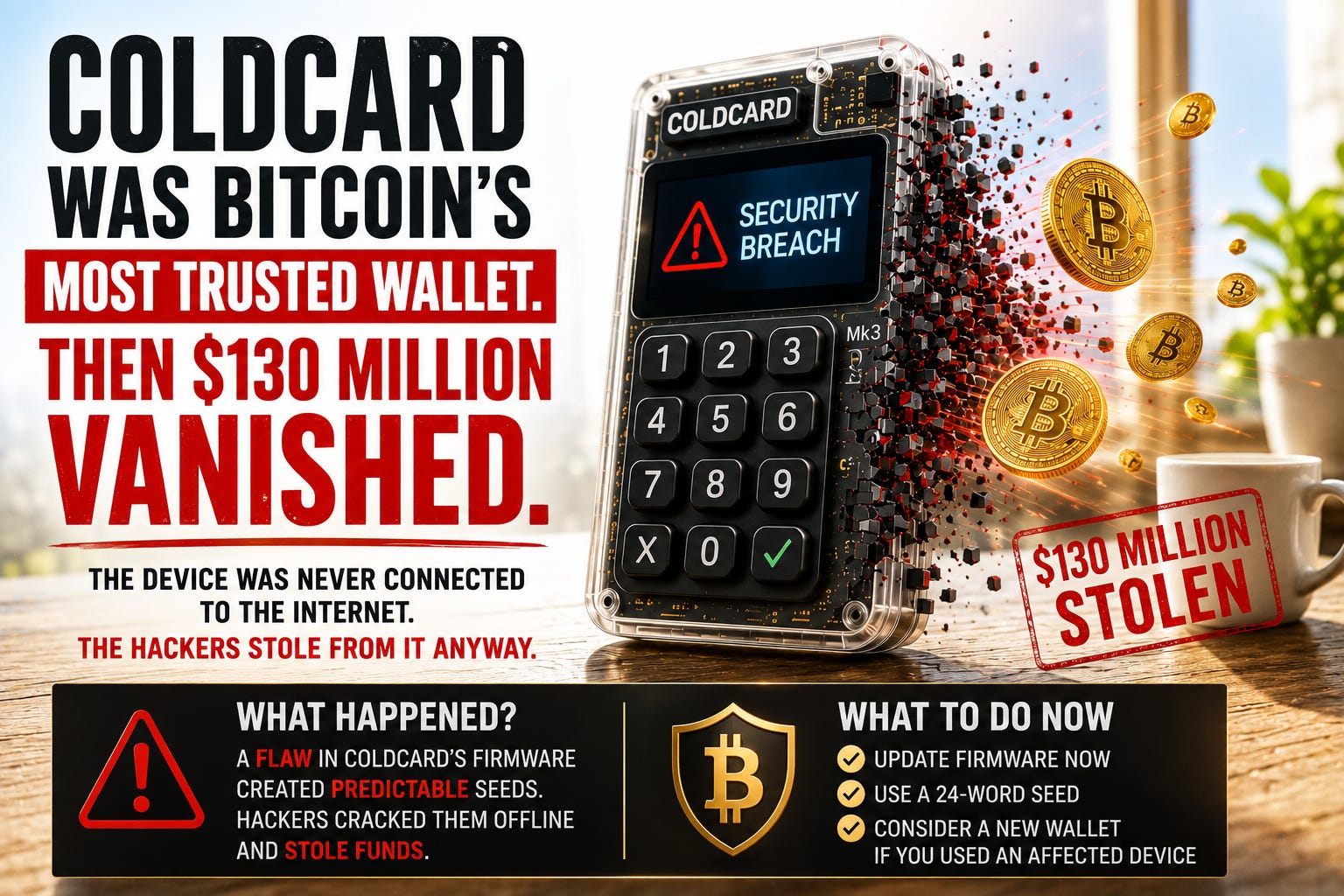
Coldcard was one of the most respected “cold storage” hardware wallets in Bitcoin, a small offline device designed to keep your Bitcoin safe precisely because it never touches the Internet. This week, security researchers confirmed that attackers had drained more than $130 million from thousands of Coldcard wallets, without ever physically touching the devices or tricking anyone into handing over their seed phrase. That combination, an offline device, no user mistake, still robbed, is what has shaken confidence in this particular product this week, and it is worth understanding exactly why, especially if you are one of the customers affected.
A House of Coldcards
Every Bitcoin wallet is protected by something called a seed phrase: 12 or 24 ordinary-looking words that together represent one enormous, supposedly unguessable random number. As long as that number is genuinely random, nobody can ever guess it, and your Bitcoin is safe.
That randomness is measured in something called bits. A 12-word seed phrase gives you 128 bits of randomness. A 24-word phrase gives you 256. Each single extra bit doubles the number of possibilities someone would have to search through to guess it, so these are not small numbers. 128 bits is already considered secure enough to be the accepted minimum standard for protecting a fortune.
Here is a way to picture what a bit actually means. Shuffle a full 52-card deck properly, and there are roughly 226 bits worth of possible orderings, comfortably more than the 128-bit standard, though still slightly short of what a full 24-word seed phrase provides. To match Bitcoin’s 128-bit minimum, you would need to shuffle 35 cards, not all 52. The compromised Coldcard Mk3 wallets, by contrast, had randomness equivalent to shuffling roughly 15 playing cards, about 40 bits, a genuine sense of just how badly things went wrong.
It gets worse still, because it was not just that Coldcard used too few metaphorical cards. The “dealer” shuffling them was also bad at its job: the firmware’s fallback random number generator was not truly random, and it produced patterns that could be predicted once you understood how it worked. So attackers were not blindly guessing from scratch. They only needed to try the combinations most likely to follow a known, flawed shuffle, and on a modern computer, that kind of narrowed search takes minutes, not the years or centuries a properly random 128-bit number would require.
How Do You Steal From a Device That Was Never Online?
The problem traces back to a firmware update Coinkite pushed in March 2021. Instead of using the device’s dedicated hardware chip built specifically to generate true randomness, a bug caused Coldcard devices to fall back on that flawed, predictable software substitute. The severity depended on the model: roughly 40 bits on the older Mk3, and roughly 72 bits on the newer Mk4, Mk5, and Q devices (about 23 shuffled cards’ worth), which mixed in a little genuine hardware randomness but not nearly enough to reach the intended 128.
Once attackers cracked the pattern, they did not need to touch anyone’s device, trick anyone into clicking a link, or steal anyone’s seed phrase. They simply worked out which seed phrases the flawed firmware was likely to have generated, reconstructed the private keys offline, and swept the funds directly. The first wave hit on July 30, draining roughly $38 million from around 500 wallets in just 25 minutes. By this week, cumulative losses had climbed past $130 million.
One important point that is easy to miss: the flaw lives in the seed itself, not in the physical Coldcard device. If you moved away from Coldcard at some point in the past but carried your original Coldcard-generated seed phrase over into a different wallet or vendor, you are still at risk today. Getting rid of the device changes nothing if the same underlying seed is still the one protecting your funds.
What Should You Actually Do?
If you use any Coldcard device, do not wait, and do not simply update the firmware and carry on as before. Updating alone does not fix a seed that was already generated while the bug was active. The number itself is compromised, no matter what firmware you run afterwards. Here is the safest path, in order.
Get a new hardware wallet from a different manufacturer that has publicly confirmed it is not affected by this specific bug. Bitkey, Ledger and Trezor, for example, have all done so, and there may be others by now.
Set the new wallet up completely from scratch. Do not restore your old Coldcard seed phrase onto it. That seed is the compromised part. Carrying it over defeats the entire point.
Generate a brand new Bitcoin receiving address on the new wallet.
Send a small test amount first, $5 or $10 of Bitcoin, from your old Coldcard to the new address, just to confirm everything is set up correctly.
Once that test transaction has fully confirmed on the network, move everything else across the same way.
If you do not have a spare hardware wallet sitting at home and cannot get to a store today, time still matters more than perfection. A temporary software wallet, or moving funds to a reputable exchange in the short term, is safer than leaving Bitcoin protected with a Coldcard seed right now. An old, otherwise unused phone with a reputable wallet app such as Cupcake Wallet in air-gap mode can even act as a rough stand-in for a hardware wallet in the meantime.
None of these temporary options are as secure as a proper hardware wallet long term, and they carry their own separate risks, but none of those risks are as immediate, real, and currently being actively exploited as leaving funds on a compromised Coldcard seed. As soon as a genuine replacement hardware wallet is in hand, move the funds off the temporary option using the exact same process: new wallet, new seed, test transaction first, then the rest.
If you do not own a Coldcard, there is still a genuinely useful lesson here. A wallet can look completely secure, offline, tamper-proof, never connected to the Internet, and still fail at a step you can never personally see: how the device generated your seed phrase in the first place. That is not a reason to distrust self-custody generally. It is a reason to understand that the strength of your setup depends on more than owning the right device. It depends on the firmware behind it too.
Doesn’t Open Source Mean Someone Would Have Caught This?
Coldcard’s firmware is fully open source, published on GitHub for anyone to read. That is usually held up as one of the great strengths of Bitcoin-adjacent software: because the code is public, the theory goes, thousands of eyes can review it, and a serious flaw simply cannot hide for long. This bug sat there for over five years without anyone catching it, and it is worth being honest about why, because the answer says something useful about open source software generally, not just about Coldcard.
The theory assumes people actually show up to look. In practice, most developers are busy, and reading through someone else’s unfamiliar codebase line by line is tedious, unpaid work that nobody particularly enjoys. Being technically allowed to check the code is not the same as anyone actually doing it. Coinkite’s own account of the incident says the flaw lived in an obscure boundary between two unrelated pieces of the code, in an area outside what its internal and outside reviews typically focused on. Reviews happened, they simply never looked in the right place, for over five years.
Then AI Entered the Picture
Here is the double-edged part. The same openness that is supposed to let good-faith researchers catch bugs also lets attackers study the code just as closely, and unlike volunteer reviewers, attackers have a very direct financial incentive to look hard. Coinkite has said it believes the attacker used AI tools to find the exact flaw that its own AI-assisted review, run on the same code just weeks earlier, had completely missed. Coldcard co-founder NVK put it plainly afterwards: assume that any code which is or ever has been public is already being read by attackers and defenders alike, and that AI now finds this kind of subtle bug far faster than even experienced human engineers.
That creates a genuinely uncomfortable asymmetry: an attacker only needs to find one exploitable flaw, while whoever is defending the code needs to find and fix every single one, every time, forever. An AI tool that reviews code and reports nothing serious can feel reassuring, right up until a different AI tool, in different hands, finds the one thing it missed.
There is also a live policy wrinkle worth knowing about. In June 2026, US authorities temporarily restricted international access to Anthropic’s most advanced models, Fable and Mythos, over national security concerns tied specifically to cybersecurity capability. Access was restored a few weeks later, reportedly after Anthropic agreed to build in additional cybersecurity safeguards. Those safeguards appear to be exactly what still limits Fable today: users of Claude Code have reported the model flagging cybersecurity and biology related prompts and stepping the session down to a less restricted model instead. In other words, this is not just a resolved dispute from a few months ago. The government action and the standing restriction on Fable’s security capabilities look like the same story, one causing the other. Leading Chinese AI labs are not known to build in equivalent restrictions on their own models. The practical concern is straightforward: if the most capable Western AI tools are deliberately held back from this kind of security work, while other AI models anywhere in the world remain free to be pointed at the same publicly available code by anyone with bad intentions, defenders may end up a step behind attackers rather than ahead of them.
Open Source Isn’t the Same as Independently Audited
None of this makes closed source the obvious answer either. If Coldcard’s code had never been public, outside attackers could not have picked through it looking for this flaw, but there would also have been no chance of an independent researcher spotting it and quietly reporting it before anyone got hurt. Every serious hardware wallet maker has to choose some mix of open source transparency and paid, professional third-party audits, and it is worth being accurate about where each one actually sits. Ledger is the clear standout for the audit-heavy approach: it has spent years publicly touting independent certified audits of every new device it releases, carried out by outside laboratories in France, alongside its own internal security team and a bug bounty programme.
Trezor and Bitkey, by contrast, lean primarily on the same pitch Coldcard does, fully open source code that anyone can inspect, with Trezor adding certified hardware chips on top, but neither publicising an ongoing paid firmware audit trail in the way Ledger does. Coinkite’s own public account of this incident points mainly to internal reviews and a general historical record of “professional reviews,” without the same kind of ongoing, certified, third-party audit trail Ledger champions. That does not prove no outside review of Coldcard’s code ever happened, but the absence of a similar claim is itself telling, and it is a reminder that “open source” alone, even across several well-regarded wallet makers, is not automatically the same thing as “independently audited.”
The real lesson from this incident is not that open source failed, or that audits are pointless. It is that “the code is public” and “the code has genuinely been checked properly” are two very different claims, and it is worth knowing which one is actually true for anything holding your money.
The Industry’s Response: A New Security Fund
Perhaps not entirely coincidentally, this week also brought news that nine major financial and crypto institutions, including BlackRock, Coinbase, Fidelity, ARK Invest, and Strategy, have formed something called the Bitcoin Security Consortium. The group has pledged $15 million over three years to fund the open-source developers who maintain and improve Bitcoin’s security, including work on post-quantum cryptography, the defence against future quantum computers we covered in an earlier article.
It is a small amount of money relative to the size of the companies involved, but it is a meaningful signal. The Coldcard exploit was a reminder that security work most people never think about, firmware, random number generation, cryptographic upgrades, is exactly the kind of unglamorous engineering that prevents the next $130 million loss. Wall Street quietly funding more of it is a good thing, however modest the number.
The Clarity Act Finally Gets Its Vote. But Still Needs to Win It.
Away from the security story, the Clarity Act took a real step forward this week. Senate Majority Leader John Thune confirmed the bill will get an actual floor vote before the August recess, something that looked genuinely uncertain a fortnight ago when it was shelved for other priorities.
The hard part is not over. Republicans hold 53 Senate seats, and passing the bill requires 60 votes to overcome a filibuster, meaning at least seven Democrats need to cross over, a real hurdle, not a formality. A successful vote would be the single biggest regulatory moment in Bitcoin’s history and could spark a significant rally. Falling short pushes the whole process into next year, closer to the 2026 midterms, where getting anything done becomes considerably harder.
The Rest of the Week, Briefly
Bitcoin rebounded above $64,000. Reports of a possible diplomatic breakthrough between the US and Iran over the Strait of Hormuz eased fears of a wider conflict, pulling oil prices down and lifting risk assets broadly, Bitcoin included.
ETF outflows reversed. After more than $526 million left US spot Bitcoin ETFs over four brutal days, the trend flipped on August 4, with over $170 million flowing back in, more than half of it into BlackRock’s IBIT alone.
A dormant whale moved $1.04 billion. A wallet that had not moved in seven months suddenly transferred 16,400 Bitcoin to a new address. Nobody knows why for certain, but it coincided with a broader spike in large transactions, which some researchers link to holders reorganising their security setups in the wake of the Coldcard news.
Strategy sold more Bitcoin. Michael Saylor’s company offloaded 1,638 Bitcoin for roughly $105 million, continuing its recent shift toward building cash reserves rather than pure accumulation. It still holds 843,775 Bitcoin.
Cathie Wood bought the dip. ARK Invest added to its positions in Coinbase, Circle, and Robinhood this week, signalling continued long-term conviction in crypto infrastructure even as headlines turned negative.
The Clarity Act floor vote is expected before the Senate’s August recess. I’ll cover the result the moment it happens. Make sure you’re subscribed.
And Finally…
Jim Cramer Panic-Sells. Crypto Twitter Celebrates.
CNBC host Jim Cramer announced live on air this week that he plans to sell his entire Bitcoin holding, citing fears that quantum computers will break Bitcoin’s security within three years. Crypto social media did not react with concern. Thanks to the long-running “Inverse Cramer” meme, the theory that whatever Cramer does, the opposite tends to happen, his announcement was instantly treated as a bullish signal. Sure enough, US Bitcoin ETFs pulled in $170 million the very next day. The quantum threat itself is real and worth taking seriously, but is still a long way off, as we have covered before. Cramer’s timing, less so.
Quick Questions
Q: Do I need to worry if I do not own a Coldcard wallet?
A: No direct action needed, but it is worth checking which hardware wallet you use and whether it has ever had a similar firmware issue. This exploit affected one manufacturer’s specific firmware bug, not Bitcoin or hardware wallets in general.
Q: If I update my Coldcard firmware, am I safe now?
A: Not automatically. Updating fixes future seed generation, but it does not repair a seed that was already created while the bug was active. You need to generate a brand new seed on the patched firmware and move your funds to it.
Q: Does this mean self-custody is more dangerous than just using an exchange or ETF?
A: No. It means self-custody requires understanding the whole chain, not just owning a device. Exchanges and custodians carry their own risks, including hacks and insolvency. This incident is a reason to be diligent about firmware and setup, not a reason to hand your Bitcoin to someone else.