


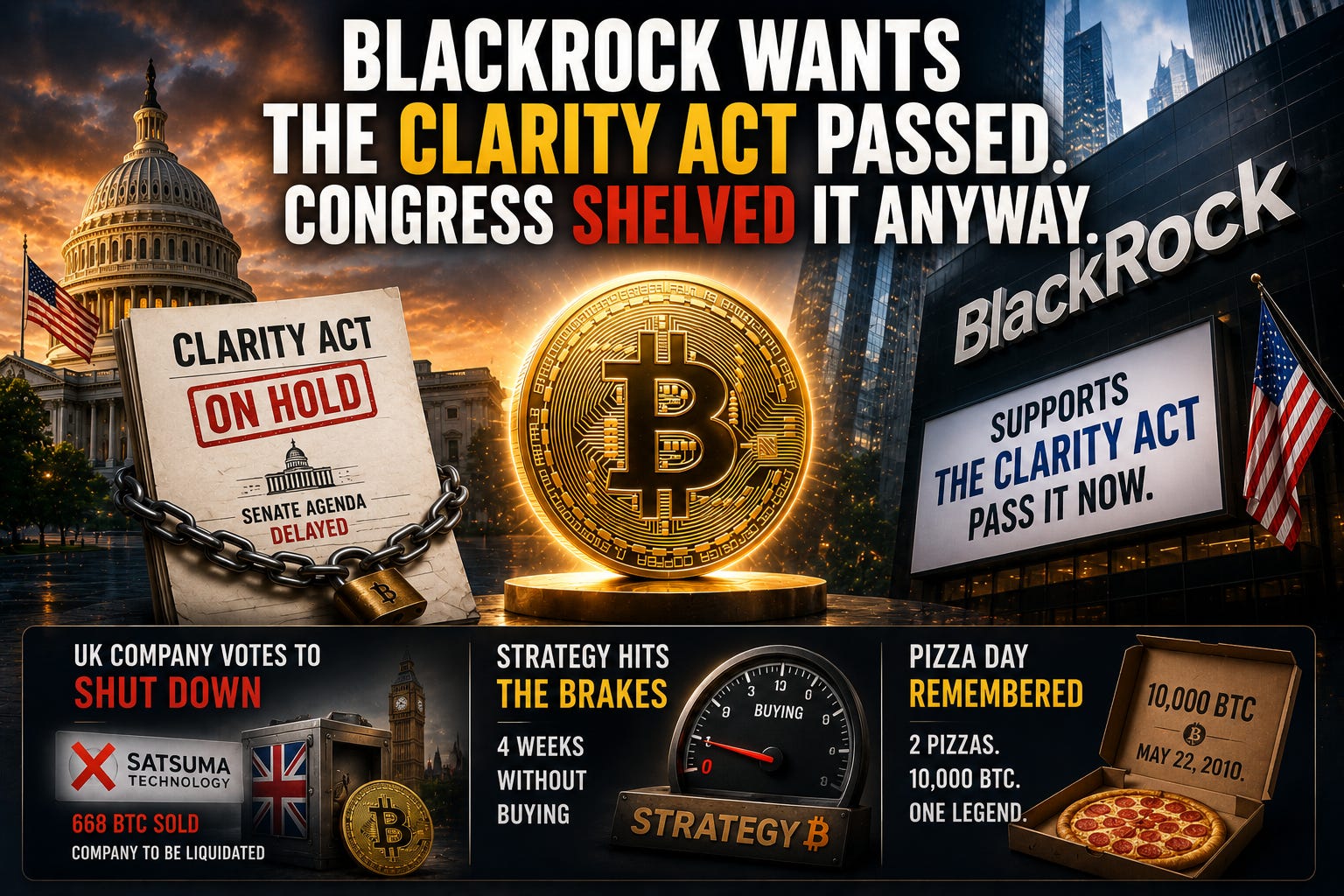
Why Did Congress Shelve Its Own Biggest Crypto Bill?
The US Senate quietly put the Digital Asset Market Clarity Act to one side this week, choosing to spend its limited time before the August recess on a Russia sanctions bill and a batch of judicial nominations instead. In plain terms: not enough political will, not enough hours in the day, and other things jumped the queue. It now looks very unlikely the bill gets a vote before Congress breaks for summer, which pushes any real decision further into the year.
That matters because the Clarity Act is the single piece of legislation that would finally tell everyone — banks, exchanges, and ordinary investors — exactly how Bitcoin and other crypto assets are regulated in America. Right now nobody has that clarity, hence the name. Bitcoin dipped below $65,000 over the weekend as investors absorbed the news that certainty was, once again, being pushed back.
The Twist: Wall Street Wants This Bill More Than Washington Does
Here is the part that makes this week genuinely interesting rather than just another delay. BlackRock — the largest asset manager on the planet, running trillions of dollars — has formally endorsed the Clarity Act, joining a growing list of major financial firms publicly pressing the Senate to pass it. Samara Cohen, BlackRock’s Global Head of Market Development, called the bill “an important step toward establishing a regulatory framework for digital assets that puts investors first,” arguing it would support innovation while keeping the transparency and investor protections her clients expect.
It is worth understanding why BlackRock in particular cares so much. Its Bitcoin ETF, IBIT, has pulled in over $63 billion since launch — one of the fastest-growing ETFs Wall Street has ever seen. Every dollar in that fund sits inside a regulatory grey area for as long as Congress refuses to spell out clearly which US regulator actually oversees Bitcoin and the rest of the crypto market long term. Clear rules do not just sound nice to a company like BlackRock. They protect a genuinely enormous and fast-growing business line from the risk of a future regulator deciding, after the fact, that the rules were something different all along.
When a bill gets shelved despite the world’s biggest financial institution actively pushing for it, that tells you the holdup has nothing to do with whether serious money wants this. It has everything to do with politics.
And the politics are genuinely stuck. Senate Democrats, led by Richard Blumenthal and Chris Van Hollen, held a public forum this week specifically examining President Trump’s personal crypto investments, which reportedly generated $1.4 billion for his family businesses last year. The core disagreement holding up the bill is whether the new rules should stop government officials from issuing or promoting their own crypto products while they are the ones writing the rules for everyone else. Until that gets resolved, BlackRock can lobby all it likes.
The Fed Decision Everyone Is Waiting On
The Federal Reserve announces its interest rate decision on July 29, and most people expect rates to stay exactly where they are. But the odds of a surprise rate hike have crept up to around 37% this week, driven by inflation concerns that refuse to go away. That uncertainty alone was enough to spook some investors, contributing to $465 million leaving Bitcoin ETFs on Thursday and Friday — even after three straight weeks of money coming back in overall.
The pattern should feel familiar by now. Higher rates make cash and bonds pay more, which makes an asset like Bitcoin that pays no interest look less attractive by comparison. Nothing has changed about that relationship. What has changed is that the market is currently pricing in slightly more chance of a hawkish surprise than it was a few weeks ago.
A UK Bitcoin Company Just Voted to Give Up
Away from Washington, there was a much smaller but genuinely important story this week. Shareholders of Satsuma Technology, a UK-listed company that had built its entire business around holding Bitcoin on its balance sheet, voted overwhelmingly to sell its entire 668 Bitcoin holding — worth around $43.5 million — and shut the company down.
This is the first time we have seen a public Bitcoin treasury company actually unwind completely, rather than just pause buying or sell a small slice to cover costs. Reports suggest as many as twenty public companies globally are quietly stepping back from the “buy Bitcoin and hold it forever” strategy that became fashionable over the last two years. Satsuma is the clearest example yet of what happens when that strategy meets a falling share price: shareholders eventually decide the risk of holding a volatile asset on a company balance sheet is not worth it, and vote to cash out.
This does not mean the corporate Bitcoin treasury idea is finished. Strategy, the largest of these companies, still holds 843,775 Bitcoin. But Satsuma is a real, concrete example of the downside risk we have discussed in the abstract in previous articles — and a useful reminder that not every company copying this playbook has Strategy’s scale or staying power.
Speaking of Strategy, It Has Stopped Buying
Strategy confirmed this week that it made no new Bitcoin purchases between July 20 and July 26 — the fourth week in a row without adding to its stack. Instead of buying more Bitcoin, the company raised $544.5 million by selling shares.
Four weeks without a purchase is a genuinely long pause for a company that built its entire reputation on buying Bitcoin relentlessly, in good times and bad. It does not necessarily mean Saylor has lost conviction. Raising cash rather than spending it can just as easily mean the company wants a bigger safety buffer before committing more, especially with Bitcoin’s price sitting well below its highs. But after weeks of covering dividend payments and rebuilding reserves, a fourth straight week of silence on the buying front is worth noting plainly rather than explaining away.
Quick Hits
The EU tightens the net. Brussels adopted its 21st sanctions package against Russia this week, which for the first time includes a transaction ban on fourteen named crypto platforms operating out of places like the UAE, Panama, and Georgia. There is also a new mechanism allowing the EU to ban entire countries’ crypto services if they are found to be helping Russia dodge sanctions. Any crypto business wanting to keep access to European customers now has a strong incentive to tighten its compliance.
Minnesota bans Bitcoin ATMs. From August 1, operating a cryptocurrency kiosk in Minnesota becomes illegal, with existing machines required to be removed by the end of the year. The stated reason is fraud and scam prevention, and Minnesota now joins Indiana and Tennessee in restricting this increasingly common on-ramp into crypto for cash-based customers.
Uphold cuts staff. Crypto platform Uphold laid off 85 people — about 17% of its workforce — as it shifts focus away from everyday retail customers and towards banks and larger institutional clients. It is another small data point in a pattern we have flagged before: retail trading interest has cooled considerably in 2026, and platforms built around retail volume are having to adapt or shrink.
The Clarity Act now looks unlikely to move before the August recess. I’ll cover it the moment there is real news, not just noise. Make sure you’re subscribed.
And Finally…
The Pizza That Still Haunts Everyone
A viral clip made the rounds again this week retelling the story of the man who once paid 10,000 Bitcoin for two pizzas back in Bitcoin’s earliest days. At Bitcoin’s 2025 peak, those two pizzas would have been worth roughly $690 million. As the caption dryly put it: he got the pizzas, he did not keep the Bitcoin. Somewhere out there, another meme is doing the rounds of two people on a small boat, one much older than the other, captioned “if Bitcoin fails, my retirement plan is Doris.” Gallows humour, but it does capture the mood of anyone still waiting for their portfolio to turn a profit.
Quick Questions
Q: Is the Clarity Act dead?
A: No, just delayed again. It has been pushed behind other Senate priorities and is unlikely to get a vote before the August recess, but it has not been cancelled or rejected.
Q: Does BlackRock lobbying for the bill mean it will pass?
A: Not on its own. BlackRock wanting clear rules adds pressure, but the actual holdup is a political disagreement between parties over ethics rules for government officials’ crypto holdings, which BlackRock cannot resolve by lobbying alone.
Q: Should I be worried that a Bitcoin company just liquidated?
A: Not about Bitcoin itself. Satsuma’s collapse is a lesson about the risks of a single company holding a volatile asset on its balance sheet, not a sign that Bitcoin as an asset is in trouble. Bitcoin held directly by you is unaffected by one company’s business decisions.