


Why Did Bitcoin Fall on News That Didn’t Actually Change Anything?
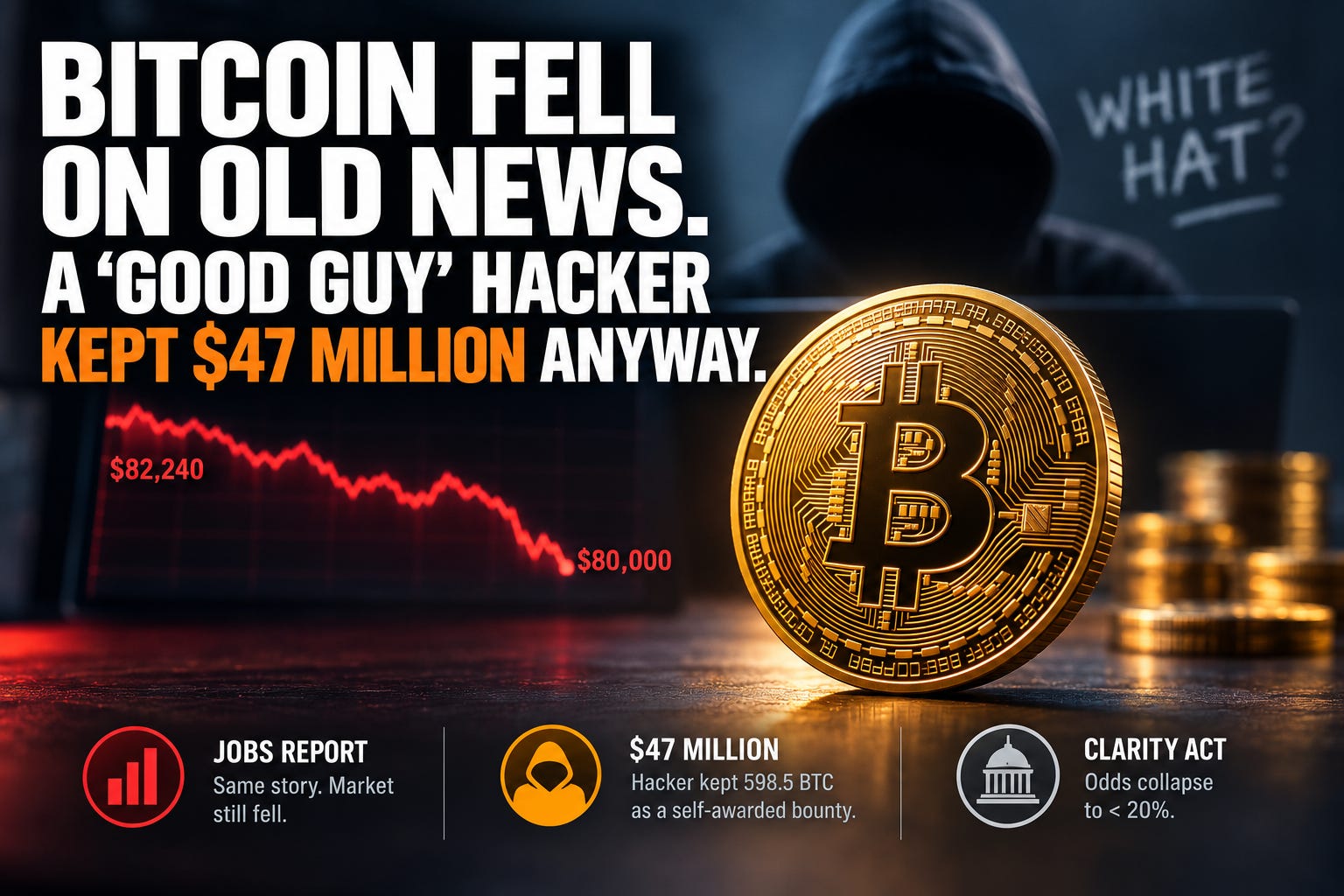
Bitcoin touched a four-month high of $82,240 midweek, then fell back below $80,000 after August’s US jobs report landed on Friday. The economy added 162,000 jobs, roughly three times what economists expected. Normally, a number that strong makes a rate hike more likely, and traders reacted exactly as if that had just happened.
Except it had not, not really. The odds of the Federal Reserve raising rates at its September meeting sat at 58% the day the jobs report came out. Those same odds had been sitting at 58% for the entire week beforehand too. The genuine shift in expectations happened the week before, when new Fed Chair Kevin Warsh gave the hawkish Jackson Hole speech we covered last week. Friday’s jobs number did not tell traders anything new about what the Fed is likely to do. It just reminded everyone of something they already knew, and spot markets reacted with fresh panic to old information.
That distinction matters if you are trying to make sense of the price chart. A market reacting to genuinely new information tends to hold its new level. A market reacting emotionally to a reminder of something already priced in tends to drift back once the mood passes. Which one this turns out to be should become clear fast, with US inflation data landing September 11 and the Fed’s actual decision following just days later.
The Biggest Bitcoin Hack Nobody Fully Agrees Was a Hack
The single largest Bitcoin-related security event of the year happened this week, and it is genuinely more complicated than a simple theft. Around $320 million was drained from the Liquid Network, a system run by Blockstream that banks and exchanges use to settle Bitcoin transactions faster and more privately than the main network allows.
Worth being precise about what broke. This was not a flaw in Bitcoin itself. Liquid is a separate side system, and the bug sat in software called Elements that handles Liquid’s privacy features. Whoever found it did not steal any private keys and did not compromise the hardware securing the network. They found a software bug and used it.
What happened next is the unusual part. The people who took the funds identified themselves publicly as white hats, hackers who break in to expose a flaw rather than to simply steal, and said they would return the money once the bug was properly fixed. Within about two days, they sent back 3,400 of the roughly 4,000 Bitcoin taken. They kept 598.5 Bitcoin, worth about $47 million, describing it as a bounty they had awarded themselves for finding the flaw. Nobody asked them to set that price. The network remains paused while Blockstream and its partners fix the underlying bug and prepare to bring it safely back online.
The Clarity Act’s Odds Have Collapsed
We have followed the Clarity Act, the bill meant to finally settle how crypto is regulated in America, for months now. This week brought the clearest sign yet that it may not make it. The bill faces what is called a cloture vote in the Senate on September 15, a procedural step that exists specifically to stop a small group of senators talking a bill to death rather than letting it come to an actual vote. Cloture needs 60 votes to succeed, a much higher bar than the simple majority needed to pass the bill itself once debate is allowed to end. Republicans hold 53 seats, and only two Democrats backed the bill when it went through committee.
The sticking points have not really changed: whether stablecoins should be allowed to pay yield, which banks oppose, how much legal responsibility software developers should carry for how their code gets used, and rules restricting elected officials from holding crypto while writing the laws that govern it. What has changed is the calendar. The House has now cancelled two more of its remaining September sitting days, leaving barely a handful of working days before Congress breaks for the run-up to the midterms. Betting markets tracking the odds of the bill actually becoming law this year have fallen from 82% back in February to under 20% now.
If cloture fails on the 15th, the realistic path forward closes for the year. A new Congress in 2027, potentially with a different party controlling the House, would likely mean starting the whole process again from scratch.
Strategy’s Comeback Buy Is Already Underwater
We told you last week that Strategy had ended its ten-week pause, buying 4,603 Bitcoin for $370 million at an average of $80,318 a coin. This week added an important detail we did not have before. During that ten-week pause, Strategy was not simply sitting still. It sold roughly 7,000 Bitcoin between March and August to help fund its preferred stock dividends, a real departure from the company’s long-standing promise to never sell.
There is also a simple, slightly awkward postscript. Bitcoin has since traded below $80,318, meaning Strategy’s comeback purchase is underwater within days of being made. None of this changes the company’s enormous underlying position. It does mean the “we’re back” narrative from last week deserves a more honest second look than it got at the time.
Quick Hits
Institutions kept buying even as the price fell. US Bitcoin ETFs took in almost a billion dollars over the week, including the single biggest day since January, even while Bitcoin itself was falling. That is a genuinely useful signal: professional money was adding to positions at exactly the moment retail sentiment was souring, which has repeatedly put a floor under this market over the past two years.
Oil is surging as the Iran conflict widens. Continued fighting near the Strait of Hormuz pushed the price of Brent crude oil toward $100 a barrel this week, with US diesel hitting a record price at the pump. This is the same story we have followed for months: an energy shock is exactly the wrong backdrop for a Fed already leaning toward higher rates, because expensive oil feeds straight into the inflation numbers the Fed watches most closely.
A crypto-native bank just got unusually close to full approval. US banking regulators gave preliminary approval to OpenReserve, a company backed by venture firm a16z, to become a genuine full-service national bank rather than the more limited licence most crypto firms have settled for. If finalised, it would let the company hold insured deposits, lend conventionally, and settle payments directly through the Fed’s own network around the clock, rather than only during normal banking hours.
The Bitcoin treasury company story keeps getting messier. Metaplanet shares fell 17% this week after shareholders revolted over a huge expansion of executive stock options and questions about the CEO’s ties to one of its own investors. Separately, the index provider MSCI is still consulting on whether to exclude companies like Strategy and Metaplanet from its stock indices altogether for holding too much Bitcoin relative to their actual business. That consultation closes at the end of September, exactly as we told you a couple of weeks ago.
US inflation data lands September 11, the Clarity Act faces its Senate test on September 15, and the Fed announces its rate decision the following day. I’ll cover all three the moment there is real news. Make sure you’re subscribed.
And Finally…
Hunter Biden Is Launching a Memecoin Called $LAPTOP
Hunter Biden announced this week that he is launching his own memecoin, named after the infamous laptop that dominated years of American political news, and explicitly aimed at people currently holding the Trump family’s own memecoin, which is down roughly 97% from its highs. Whatever else can be said about it, launching a coin named after your own most-litigated piece of personal property is a genuinely committed piece of trolling.
$240 Million in Stolen Bitcoin Bought a Lot of Very Bad Decisions
Court filings from the ongoing case against 22-year-old Malone Lam, accused of stealing more than $240 million in Bitcoin from a single victim, gave the public an itemised look at where the money went: a $569,000 single night at a Los Angeles nightclub, a $2 million watch, more than thirty supercars, and mansions in Miami and the Hamptons. One associate reportedly bought his parents a Lamborghini and hid $500,000 in cash inside a washing machine. A judge overseeing the case reportedly summed the whole thing up as “Ferris Bueller gone bad,” which is hard to improve on.
Quick Questions
Q: Did the jobs report actually cause the Fed to become more likely to hike rates?
A: Not really, that shift had already happened the week before, after Fed Chair Kevin Warsh’s Jackson Hole speech. The jobs report confirmed the existing picture rather than changing it, even though Bitcoin’s price reacted as if something new had happened.
Q: Was the Liquid Network hack a problem with Bitcoin itself?
A: No. Liquid is a separate system built on top of Bitcoin, and the bug was in software specific to that system. Bitcoin’s own network was never at risk.
Q: Is the Clarity Act definitely dead if it fails on September 15?
A: Not definitely, but the realistic window closes for this year. A new Congress in 2027 would likely need to restart the process from the beginning, which is why this specific vote matters so much.